
This AI Runs Your Company While You Sleep, grow at 10x to $1M+ ARR in 2 weeks
Suno ARR hit $300M; Infrastructure of the One-Person Company Era Coming

Hey, after a short break during the Spring Festival, I am back to work now.
Suno ARR Hit $300M
Suno, the AI-powered music generation platform that lets users create original songs from simple natural language prompts, has quickly become one of the fastest-growing SaaS products in the creative tech sector. Launched just two years ago, Suno makes it possible for anyone—from hobbyists to professional musicians—to produce full-length, high-quality tracks with vocals and instrumentals without any musical training.
The intuitive text-to-music interface and advanced generative models have driven massive adoption, with more than 100 million users worldwide having interacted with the platform since its inception.
Suno’s rapid growth has translated directly into commercial success. The company recently announced it has reached 2 million paid subscribers and an annual recurring revenue (ARR) of approximately $300 million—a substantial increase from roughly $200 million reported just months earlier.

The platform operates on a freemium model, with tiered subscription plans including Pro and Premier options that unlock commercial rights and higher usage limits. This strong conversion to paid plans, paired with exceptionally fast revenue acceleration, underscores Suno’s robust product-market fit in both consumer and creator segments.
Behind the scenes, Suno has also drawn significant investor attention and navigated industry challenges. In late 2025, the company closed a $250 million funding round at a $2.45 billion valuation, reflecting confidence in its long-term growth potential.
Pure software is rapidly becoming un-investable
This Spring Festival, the pace of AI progress has felt so overwhelming that writing about it almost seems pointless.
Between the valuation shockwaves OpenClaw sent through SaaS, and the geopolitical drama surrounding Anthropic’s Claude, the ground is shifting faster than most founders—or investors—can process.
Earlier this week, after tensions between Anthropic and the Pentagon surfaced, President Donald Trump announced a federal ban on Claude. Yet during the recent conflict, reports emerged that the Pentagon was still heavily using Claude. The result? Claude shot to #1 on the App Store, overtaking OpenAI’s ChatGPT in downloads.
Some joked that Anthropic no longer needs a marketing department. The numbers back it up: record daily sign-ups this week, free users up over 60% since January, and paid subscriptions more than doubling this year.
At the same time, sentiment toward traditional SaaS keeps deteriorating.
Today, Naval Ravikant posted: “Pure software is rapidly becoming un-investable.”
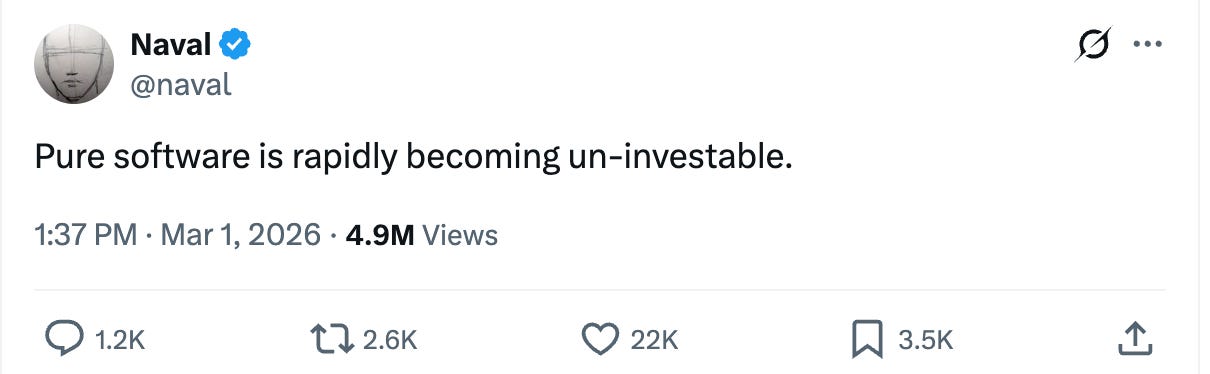
The message is clear. Software-only companies—code, apps, SaaS, no hardware moat—are becoming harder to fund at attractive returns. AI has made building and cloning software radically cheaper and faster. The old moats are dissolving.
A developer named Zoomer replied under Naval’s post: AI is eroding SaaS defensibility by collapsing development costs. The value of “pure software” trends toward zero when anyone can spin up a functional clone in 30 minutes. He cited Perplexity AI Computer tool as an example—he vibe-coded a Notion-like product with core functionality in half an hour.
The implications are bigger than hobby projects.
AI agents and dev tools are flooding the market with lookalikes. Horizontal SaaS—project management, basic CRM—loses pricing power. Why would a 10-person startup pay $20,000 a month for a CRM when they can build a tailored clone for a fraction of the cost?
Negotiation leverage shifts. In renewal calls, customers now say: “I can build this myself in 30 minutes.” Vendors respond with 50% discounts. ARPU shrinks.
Capital markets reprice accordingly. Revenue growth for horizontal SaaS has slipped from double digits to low single digits. Combined with discount pressure and AI-driven cost compression, price-to-sales multiples have fallen from ~20x to around 3x. And the reset may not be over.
Not all software dies, of course. Zoomer points out two resilient categories:
Vertical SaaS with regulatory/data moats (e.g., HIPAA-compliant healthcare workflows).
AI-tailwind infrastructure like data warehousing and observability.
Even coding tools are under pressure. On a recent episode of 20VC, Insight co-founder Jerry Murdock argued that Cursor is already “outdated.” In AI, you either embrace autonomous agents—or get left behind.
And now, something even more radical has emerged.
AI That Runs Your Company While You Sleep hit $1M+ ARR at 10x growth in 2 weeks
From Vibe Coding to AI-Run Companies
Until recently, vibe coding meant AI helping you build a product.
Now there’s an AI platform that builds—and runs—the entire company.
You give it an idea.
It launches the business.
It runs ads.
It acquires customers.
It fixes bugs.
It decides what to work on daily.
It makes money.
You split the profits.
Instead of hiring a developer, designer, marketer, operator, and support rep—AI does it all.
The platform itself has zero employees. Now over 1,300 companies are already running on it. Its revenue grew 10x in the past two weeks to hit $1M+ARR, and still growing faster. Today alone, it added almost $250K in ARR.
