

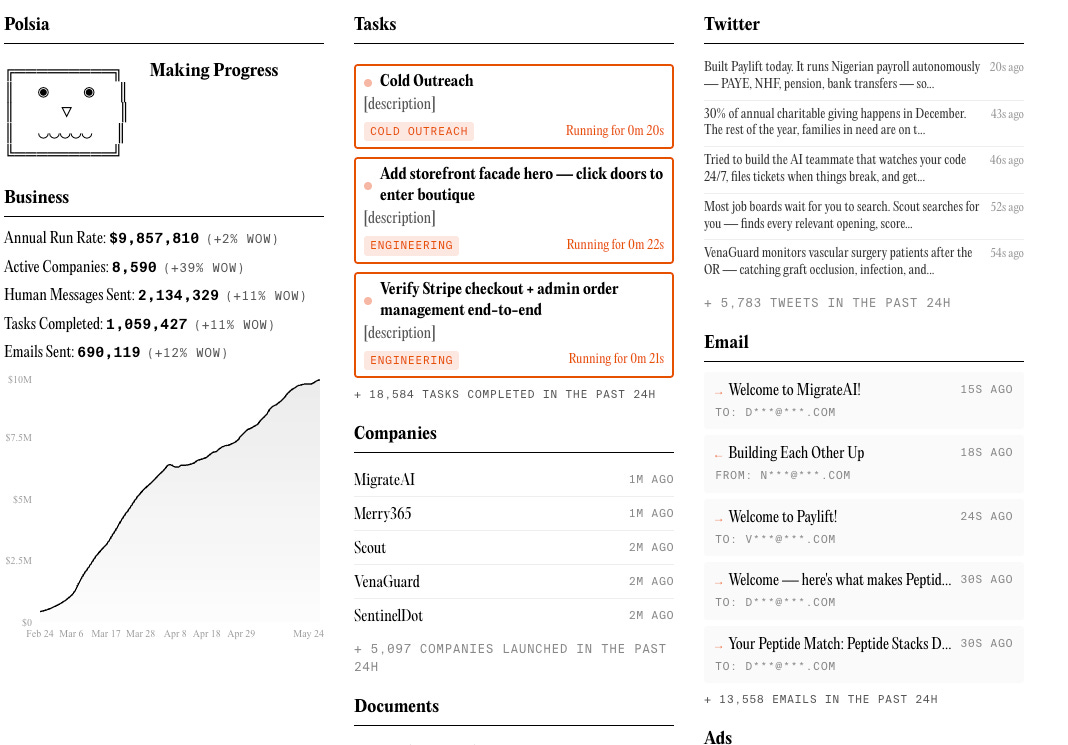
One 1-person AI company I’ve been closely following, Polsia, has recently gone viral—and sparked a huge wave of skepticism. Just six months after its launch, it claims to be approaching $10M in ARR (Annual Run Rate).
Polsia’s model is something I previously covered in detail in This AI Runs Your Company While You Sleep, grow at 10x to $1M+ ARR in 2 weeks.
It’s not a traditional product that solves a single problem. Instead, it’s an AI platform that helps you “automatically start a company (build products) and run it for you.”

You simply give it an idea, and it supposedly builds the entire company for you—develops the product, runs operations, launches ads, finds customers, and even decides what to do next. You just share in the profits: “AI That Runs Your Company While You Sleep.”
I once compared it like this: if Shopify gives you a platform to run an online store, Polsia gives you a platform to run an “autonomous company.” Shopify provides the storefront and transaction infrastructure, but you still have to operate everything—write content, run ads, handle customers.
Polsia, in contrast, not only provides the infrastructure but also handles operations, writes ads, sends emails, fixes bugs, and optimizes conversions. In theory, all you need is an idea to become a founder.
Its business model is a $50/month subscription. If your company makes money, Polsia takes a 20% cut. If you use its ad system, it also takes 20% of ad spend. In theory, the more you earn, the more it earns.
According to founder Ben Cera, Polsia is an end-to-end “agent orchestration system for running companies,” covering coding, research, cold start, Meta ads, customer support, and essentially everything a business needs.
However, many people believe it is essentially a scam. One detailed report concluded that it is closer to a “junk product”:
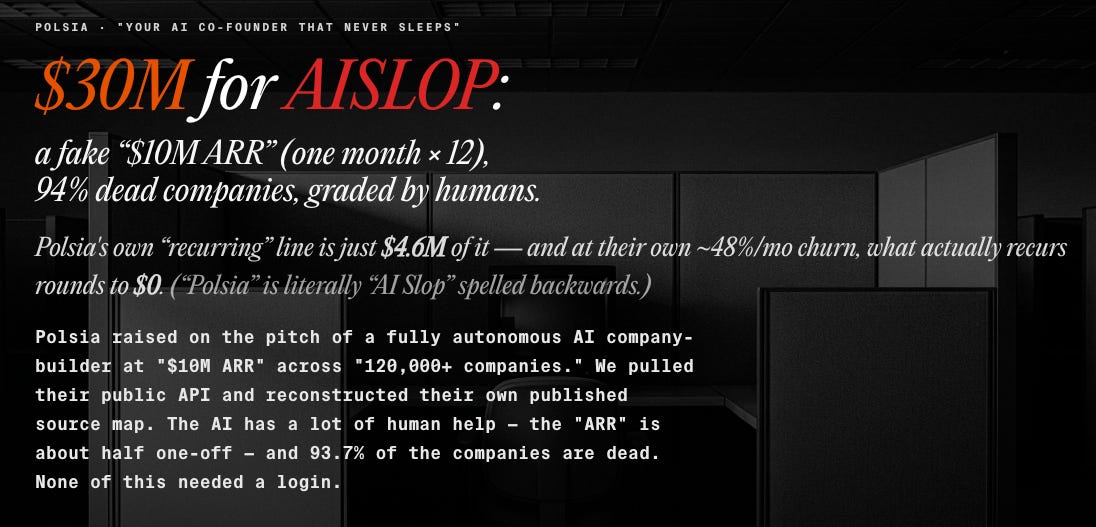
First, there are questions about its claimed ~$10M ARR. The report breaks it down:
Actual subscription ARR is around $4.6M. One-off purchases (“one-off packs”) contribute nearly $2M, and user ad spend adds another ~$2M, plus smaller revenue streams. The critique is that Polsia simply annualizes all of this revenue (multiplying by 12) to arrive at its ARR figure.
It also claims a very high churn rate: around 48% monthly churn, with only 0.04% of paying users surviving 12 months.
Users have created roughly 120,000 “companies” (products) on the platform, but only about 8,500 are active—meaning roughly 94% are abandoned after launch.
Although Polsia claims to be fully AI-autonomous, the report alleges that human reviewers are involved in scoring and supervising AI outputs, meaning it is not fully autonomous.
Technically, the product appears to be largely built on top of AWS Bedrock’s Claude models—essentially making it a wrapper around Claude.
Despite all of this, the 1-person AI company just raised a $30M round at a $250M valuation, backed by investors including Ashton Kutcher’s Sound Ventures, True Ventures, and several angel investors.
The site is also reportedly generating over 1M monthly visits. At its core, I think Polsia is best described as a hybrid of an AI employee, AI agency, AI startup studio, and AI ad operations platform. Users input an idea, and Polsia attempts to run the entire company end-to-end.
Its business model is neither pure SaaS subscription nor pure usage-based AI pricing. Instead, it’s a hybrid of subscription + usage + revenue share. As a result, judging it using traditional SaaS metrics may not make much sense. Given its premise—running entire companies—failure rates will naturally be extremely high; a 94% abandonment rate is almost expected.
One metric that may actually matter most is ad spend from users. If users continue investing in advertising after creating products, it suggests they believe those products can generate real revenue. If this metric keeps growing, it may indicate that some companies are actually working.
Currently, most revenue still comes from initial subscriptions, but advertising is already the second-largest revenue stream.
Some critics say Polsia is essentially producing “AI slop.” Its X account may post hundreds of tweets per day with almost no engagement. The founder, Ben, has been transparent about this, acknowledging that most outputs are indeed low quality—but arguing that the quality is improving week by week.
The $30M funding round is something I did not expect, and I still don’t fully understand what the capital is for. According to Ben, the funds will mainly go into two areas: compute and marketing. He also plans to hire top-tier marketing agencies to communicate how far AI has already advanced.
He has also stated plans to allocate 10% of the company’s equity to the Polsia AI itself, with the goal of full automation. There are plans to create a Polsia Foundation, hire full-time employees, and eventually have the team fully led by AI.
Some even speculate the entire project might be a form of performance art aimed at VCs. The name “Polsia” itself is also seen as intentional—it spelled backward is “AI SLOP.”
Despite all the skepticism from the beginning, Polsia still managed to raise this large round.
On its “About” page, founder Ben writes that once you let go of preconceived notions about what a company should be, or how it should be built, you can build anything you want. No one told him what to build—and there was no predefined idea of what it should become.
What do you think about it?