

Among the myriad of products out there, Obsidian stands out as an alternative. Its CEO is not a founder but an early super-user who gradually became a key contributor to the ecosystem and was later invited by the founders to take the CEO role.
Collaboration Without the Cloud
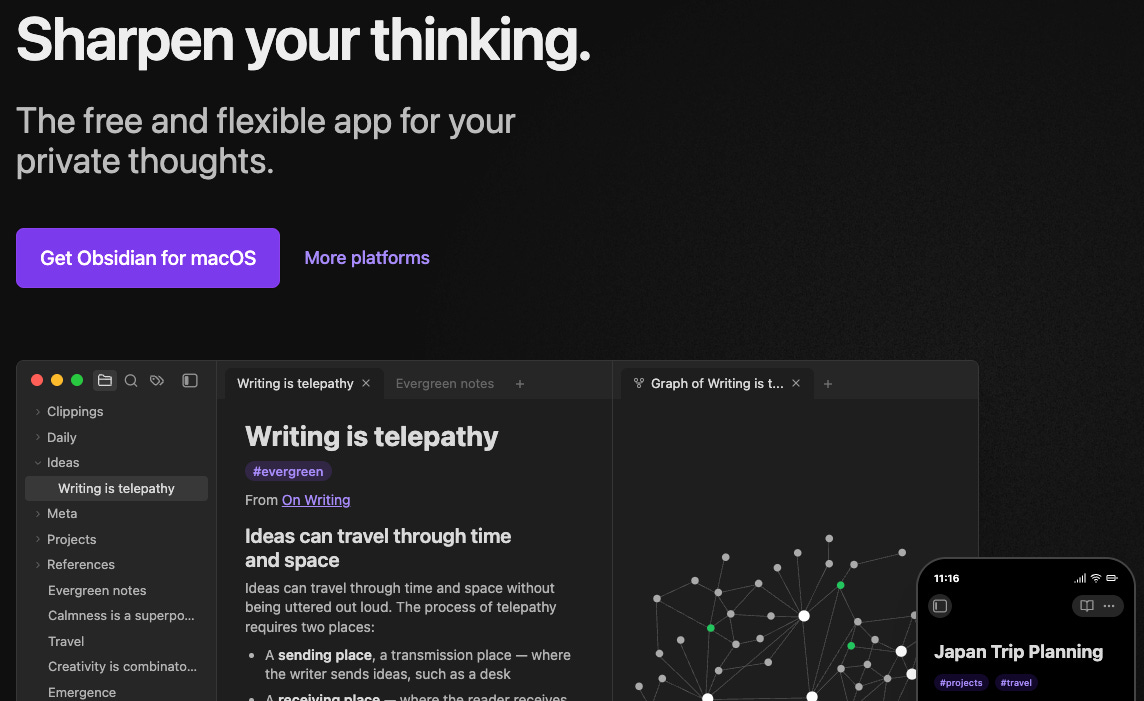
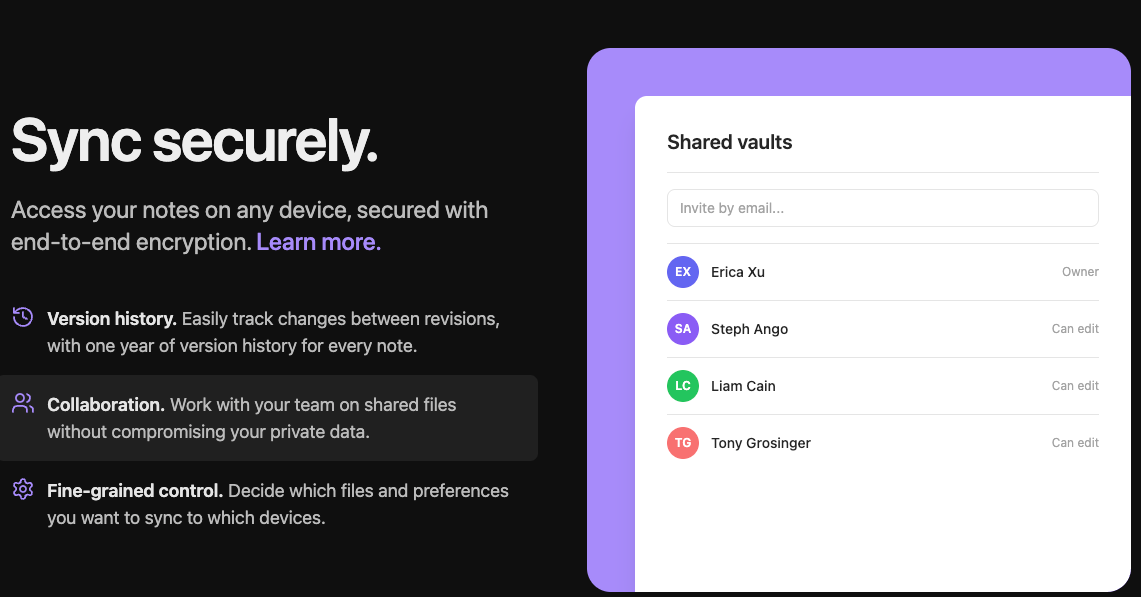
During the period when note-taking apps were expanding toward larger teams and enterprises with collaborative features, Obsidian avoided the usual Notion or Google Docs model. It doesn’t force you to store data in its cloud; instead, collaboration happens via “sync services” or “shared folders.”
Even after the AI boom, when almost every product was rebuilding around AI or adding it as a core feature, Obsidian has been extremely restrained in incorporating AI.
The team is fully remote, with only one in-person meetup per year, and virtually no recurring meetings. Everyone focuses deeply on the highest-priority work.
Yet, Obsidian has been profitable from day one and has earned a large, loyal user base. CEO Steph Ango recently estimated over 4 million users, including 10,000+ organizations.
A Tiny Team, Big Impact
Obsidian’s ARR is estimated at $25M (third-party estimate). Despite no funding, the market reportedly values it at $350M.
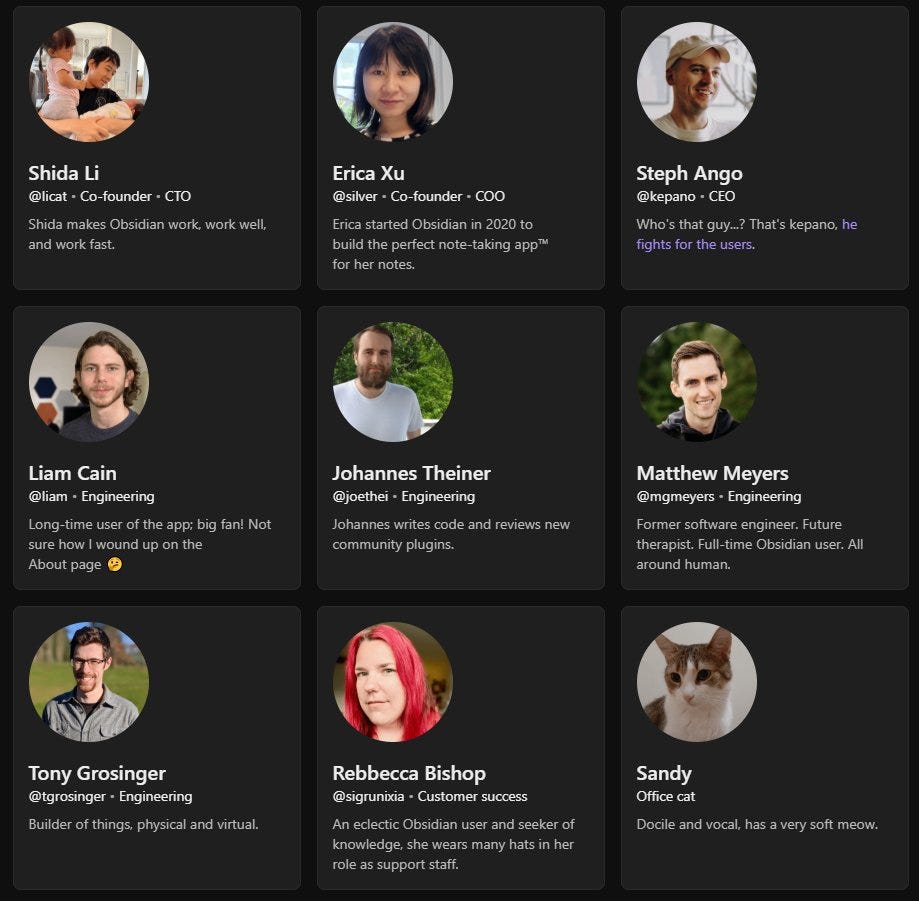
The team currently has 9 people, including a cat named Sandy, with three engineers. They are hiring a fourth engineer—bringing the team to ten—and plan to keep the full-time team around 10–12 people.
Obsidian didn’t succeed by “turning notes into a collaborative suite” or by “embedding AI everywhere.”
It succeeded by sticking to product principles, transforming a niche audience into a highly sticky, self-propagating ecosystem willing to pay.
An “IDE for Thought”
Co-founder Erica Xu defines Obsidian as an “IDE for thought”—not a tool that thinks for you, but an environment you can fully control and continuously shape.
From the start, it wasn’t about creating a “large, all-in-one collaborative suite,” but a “holy grail note-taking app” for individuals. This fostered near-religious loyalty among geeks, researchers, writers, and knowledge workers.
Founders Shida Li and Erica Xu first built Dynalist, an outlining tool. It taught them the value of structured information and heavy-user workflows—but also its limitations: users want more than hierarchy—they want links, backlinks, graph views, and local file ownership.
This led to the transition from Dynalist to Obsidian:
“From organizing items → to connecting thoughts.”
Dynalist solved “how to list things clearly.”
Obsidian solves “how to make knowledge continuously readable, linkable, and evolvable over time.”
The Five Principles
Obsidian’s manifesto highlights five core principles: Yours / Durable / Private / Malleable / Independent.
Yours: Everyone should have tools to think clearly and organize ideas effectively. Core tools are free.
Durable: Data should be future-proof and accessible anywhere. Simple, open file formats prevent lock-in.
Private: Thoughts belong to the user. Data is stored locally and encrypted end-to-end.
Malleable: Tools should adapt to your thinking, not the other way around. Obsidian is highly customizable.
Independent: Fully user-funded, no investors.
CEO Steph emphasizes “File over app”: apps become obsolete, files endure. Notes are stored as Markdown files locally, not in proprietary cloud databases.
“If you want your work to be readable on computers in the 2060s or 2160s, ensure it’s readable on 1960s computers.”
This approach sacrifices some short-term growth-friendly features (web-first collaboration, centralized data, strong lock-in), but gains trust, migration freedom, and long-term mental model value.
Adding Power Without Losing Control
Obsidian layers features like backlinks, graph view, Canvas, Properties, Web Clipper, Bases, CLI, all grounded in user-controlled files.
Bases (2025) brought “database views” while still building on local Markdown + properties. Obsidian adds Notion-style structured views without betraying its file-first philosophy.
Community-Driven Growth
Unlike many SaaS companies whose “community” is just a Discord, Obsidian’s community is an extension of the product itself.
Steph explained:
“The plugin architecture is genius not because of tech, but because it keeps the core app simple while letting the community satisfy long-tail needs.
Each user can have a unique Obsidian, so the company doesn’t need to build ‘10,000 features’ but can support ‘10,000 workflows.’”
This creates a craft-driven PLG model: users make tutorials, plugins, templates, and themes to improve their system, attracting new users organically.
Monetization Without Compromise
Obsidian is free for individuals, commercial, nonprofit, educational, and government use. Paid options are optional support and services, not core features. Revenue mainly comes from: Sync, Publish, Catalyst, and optional commercial support.
Less than 1% of users use Sync, but it generates 80% of revenue.
Sync Standard: $4/user/month (annual)
Sync Plus: $8/user/month (annual)
Emphasis: end-to-end encryption, version history, offline sync, cross-platform, shared vaults
Core users are highly sensitive to data ownership, customizability, and long-term readability: researchers, writers, developers, content creators, knowledge workers.
AI as an Auxiliary Layer
Obsidian remains restrained with AI. AI is never the main actor replacing thought—it’s an auxiliary layer, an ecosystem layer, a team lever.
Steph:
“Any AI integration must align with the Manifesto, especially privacy. User data will not go to OpenAI servers without explicit consent.”
Early AI features were community-built (e.g., Text Generator). Official roadmap features—Web Clipper Interpreter, Keychain, CLI—are peripheral AI infrastructure, connecting without violating file-first philosophy.
Selling Control, Not Notes
Obsidian embeds values into product constraints. Every decision—local-first, Markdown, encryption, plugins, no investors—is interconnected.
Obsidian sells “principled convenience,” not principle betrayal.
Sync and Publish enhance convenience without breaking “files belong to you, data local by default, portable.”
It’s not aimed at beginners, but this “thresholded love” fosters deep loyalty. Even the AI trend hasn’t swayed its core.
Steph:
“Obsidian doesn’t sell notes—it sells control.”
Impact
When Obsidian posted a recent engineering job on X, it sparked discussion and reached 8 million views.
Similar philosophy-driven products include Ghost, which I previously covered. Like Obsidian, Ghost started from the founder's needs and now has ARR over $10M.