
The More AI Models Compete, the More OpenCode Wins
OpenCode Is More Than a Coding Agent

On August 6th, OpenCode processed 7 trillion tokens in a single day. On August 7th, that number jumped to 8 trillion. One trillion more tokens — in 24 hours.
And almost nobody in mainstream is talking about this company.
Most people still think of OpenCode as an AI coding tool. That’s understandable. On the surface, it looks like an open-source Claude Code — a terminal-based coding agent that lets developers pick whatever model they want to use.
But I think that framing badly underestimates what’s actually happening here. OpenCode’s inference business is only 8 months old, and it’s already at a scale that very few AI infrastructure companies ever reach:
- 13 million MAU
- 4.6 million WAU
- ~8 trillion tokens processed per day
- 160,000 paying subscribers
- ~$58M ARR (~$40M annualized inference revenue + ~$18M subscription)
My first reaction when I saw these numbers was: *how have I barely heard of this company?* The easy answer is that they built a solid product — flexible, model-agnostic, and cheap. But I don’t think that tells the whole story.
There’s something else going on.
OpenCode chose a very unusual position.
Rather than racing to build the next frontier model, it’s building the market where different AI models compete for developers. That distinction matters a lot more than whether it’s a “better coding agent.”
Everyone assumes OpenCode is competing with Claude Code. It isn’t. Claude Code, Codex — these are all vertically integrated products. They want you locked into their ecosystem. The stronger the model, the stronger the product.
OpenCode is playing an entirely different game.
The Marketplace Flywheel
The founder said something in a recent interview that I think is worth sitting with:
We’re not betting on one model lab. We’re betting on the field.
This sounds like a small distinction. It isn’t. It completely changes the growth logic of the company.
Every other AI company has to answer: which model is going to win? OpenCode’s question is: how do we benefit regardless of which model wins?
That’s a fundamentally different problem to solve.
Every new model that comes out potentially makes OpenCode stronger. While most AI companies are forced to make a bet — GPT or Claude or DeepSeek or something else — OpenCode doesn’t have to pick. When a new open model gets good enough that developers want to try it, OpenCode is the lowest-friction place to do that.
You can already see this pattern in the data:
- Kimi gets better → users show up on OpenCode
- DeepSeek releases a new model → users show up on OpenCode
- GLM gets attention → users show up on OpenCode
OpenCode isn’t betting on a single winner. It’s betting that competition between models will intensify — and that’s a very unusual commercial position to be in.
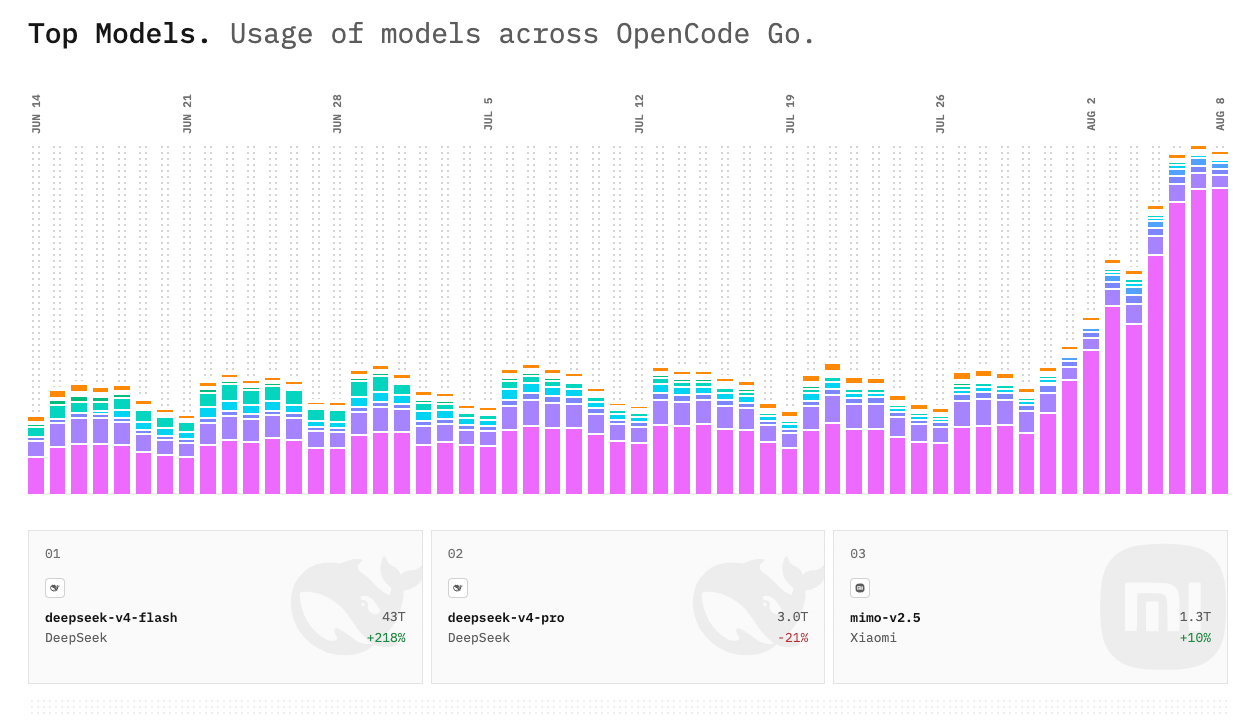
For most AI companies, a stronger competitor means lost market share. For OpenCode, more competition is the growth engine. The more models there are, the more differentiated they become, the more developers need help choosing — the more valuable OpenCode gets.
It’s worth thinking about what kind of platform this actually resembles. The closest analogies I can find are early Snowflake or Postman — tools that didn’t produce data or APIs themselves, but became the default layer where engineers actually do their work, quietly accumulating switching costs over time.
That said, OpenCode’s leverage over model providers is nothing like what App Store has over developers — model labs can technically bypass it and reach users directly. Whether it truly becomes a platform depends on whether it can build deep enough workflow lock-in on the developer side. That’s still an open question.
Platform value follows a simple rule:
More participants → more valuable platform.
And the flywheel here is entirely developer-driven — model providers don’t have to do anything except expose an API:
New model drops → developers want to try it → OpenCode is the lowest-friction entry point → more developers → more real usage data → better model recommendations and routing → developers rely on OpenCode more for model selection → repeat.
The most interesting thing about this flywheel: OpenCode doesn’t need to build the world’s best model. Anthropic improves → OpenCode benefits. OpenAI improves → OpenCode benefits. DeepSeek improves → OpenCode benefits. Kimi improves → OpenCode benefits.
As long as the AI model market keeps progressing, OpenCode grows. That’s a growth logic almost no other AI company has.
The rest of this post is for paying subscribers. Below, I get into two things I think are being almost entirely overlooked: the data asset OpenCode is quietly accumulating, and what the emerging enterprise motion tells us about where this is really heading.
