

Perplexity ARR hit $450M with 50% monthly growth
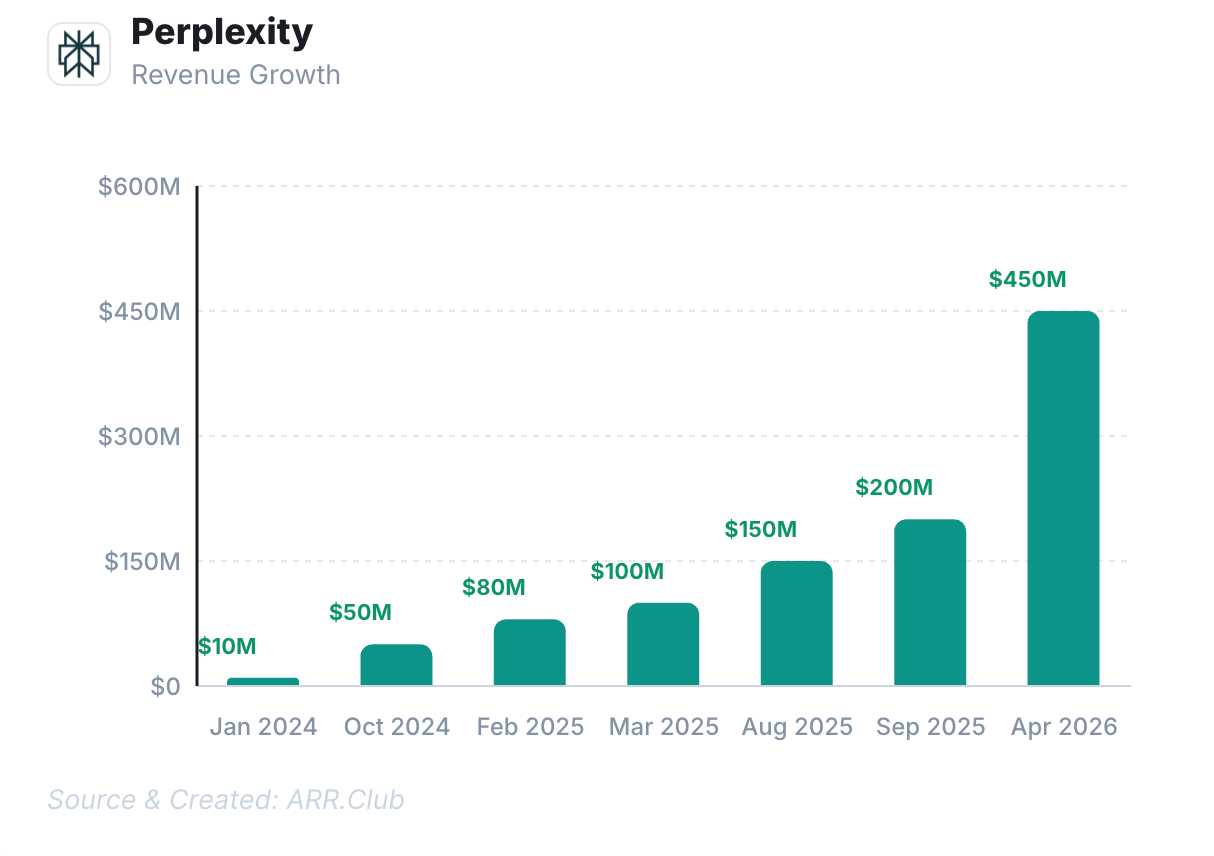
Perplexity is back, after the launch of a new agent tool Perplexity Computer, and a shift to usage-based pricing, Perplexity's estimated ARR rose to over $450M in March, jumping 50% in a month.
Perplexity Computer is an AI-driven agentic workstation designed to act as a digital "operator." Unlike standard search engines or chatbots that only provide information, it is built to execute complex, multi-step workflows.
It functions as a centralized command center where the AI uses tools, browses the web, and manages files to complete specific projects.
From Personal Agents to Team Agents: AI Is Moving Beyond Tasks — Toward a “Team Brain”
AI has been evolving along a very clear trajectory: boosting individual productivity. The interface has shifted from simple chatboxes to agents, and now to systems like OpenClaw that can independently execute parts of real-world work. The ability to complete single tasks keeps getting stronger.
We’re already seeing a transition from task-level AI to workflow-level AI. But in real work environments, that’s still not enough. Finishing one task doesn’t automatically trigger the next step. Once workflows span multiple tools—or rely on human coordination—the process breaks. Tasks stall, context gets lost, and execution fragments.
This is exactly where Kollab comes in, cofounded by my friend Zhaofei Wang.
The Missing Layer: From Tasks to Flow
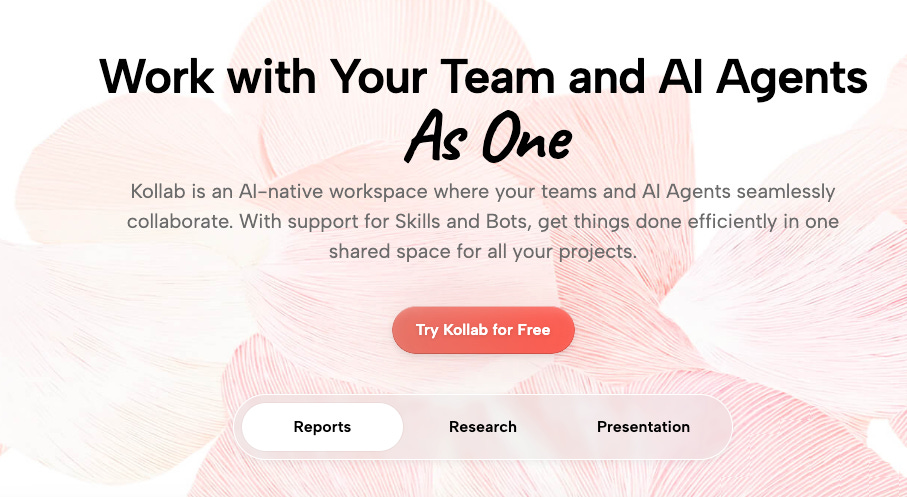
Kollab isn’t trying to make AI better at doing isolated tasks. It’s trying to solve something deeper: the fragmentation of collaboration.
Instead of helping individuals “get things done,” Kollab is designed to help teams keep things moving—end to end. The goal is simple but ambitious: once something starts, it should flow through the organization automatically, without needing constant human handoffs.
This is what you might call team-level AI.
A System Built for Teams, Not Individuals
Kollab approaches this problem through four core layers:
1. AI-Native Workspace
At the foundation is a shared workspace that brings everything—projects, tasks, documents, context, and AI outputs—into a single environment.
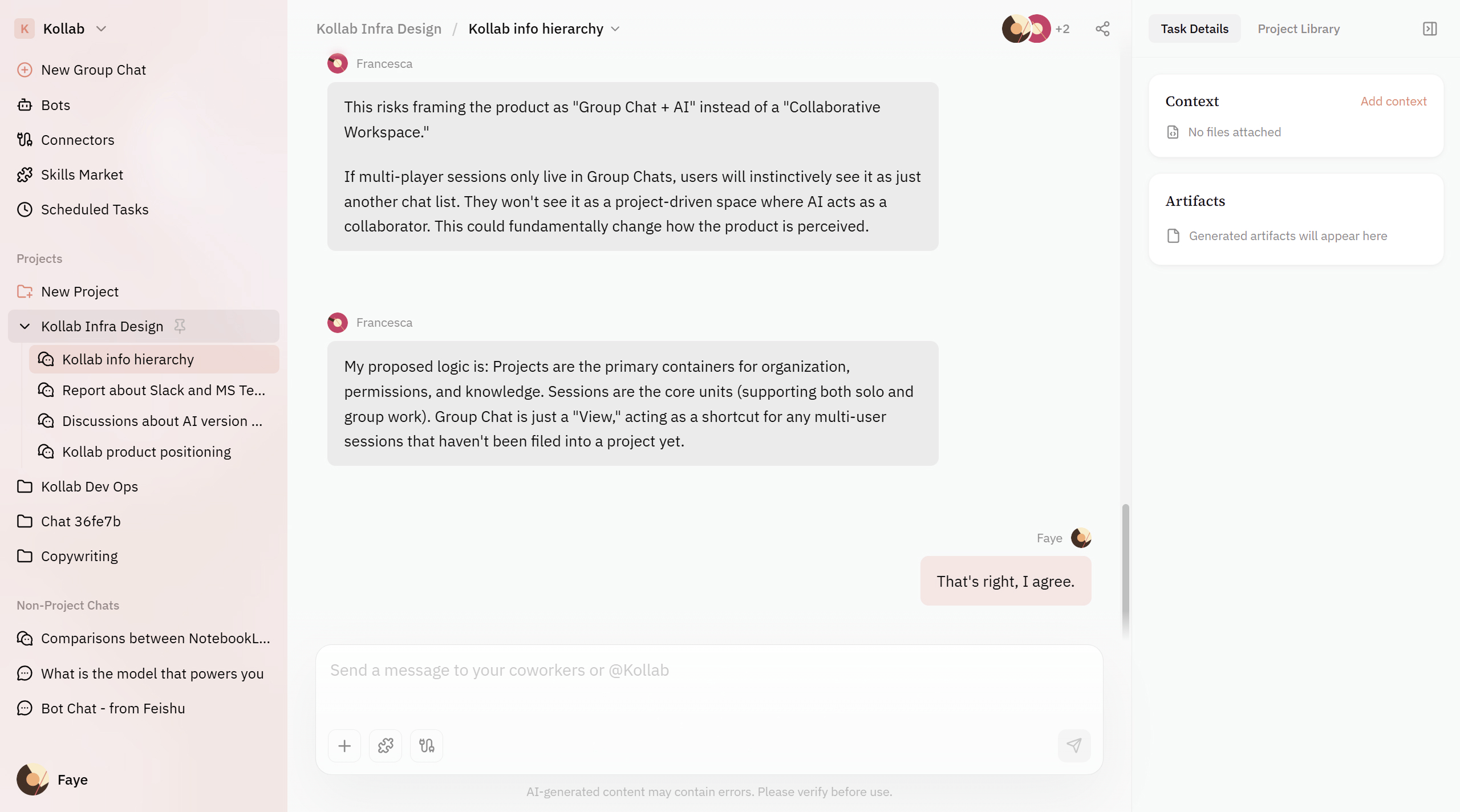
This isn’t just another chat app. It’s an AI-native workspace, where the project becomes the central unit. Around it, discussions, documents, code, design assets, and agent activity all live in the same context.
The idea is simple: instead of scattering work across tools, bring execution into one cohesive layer.
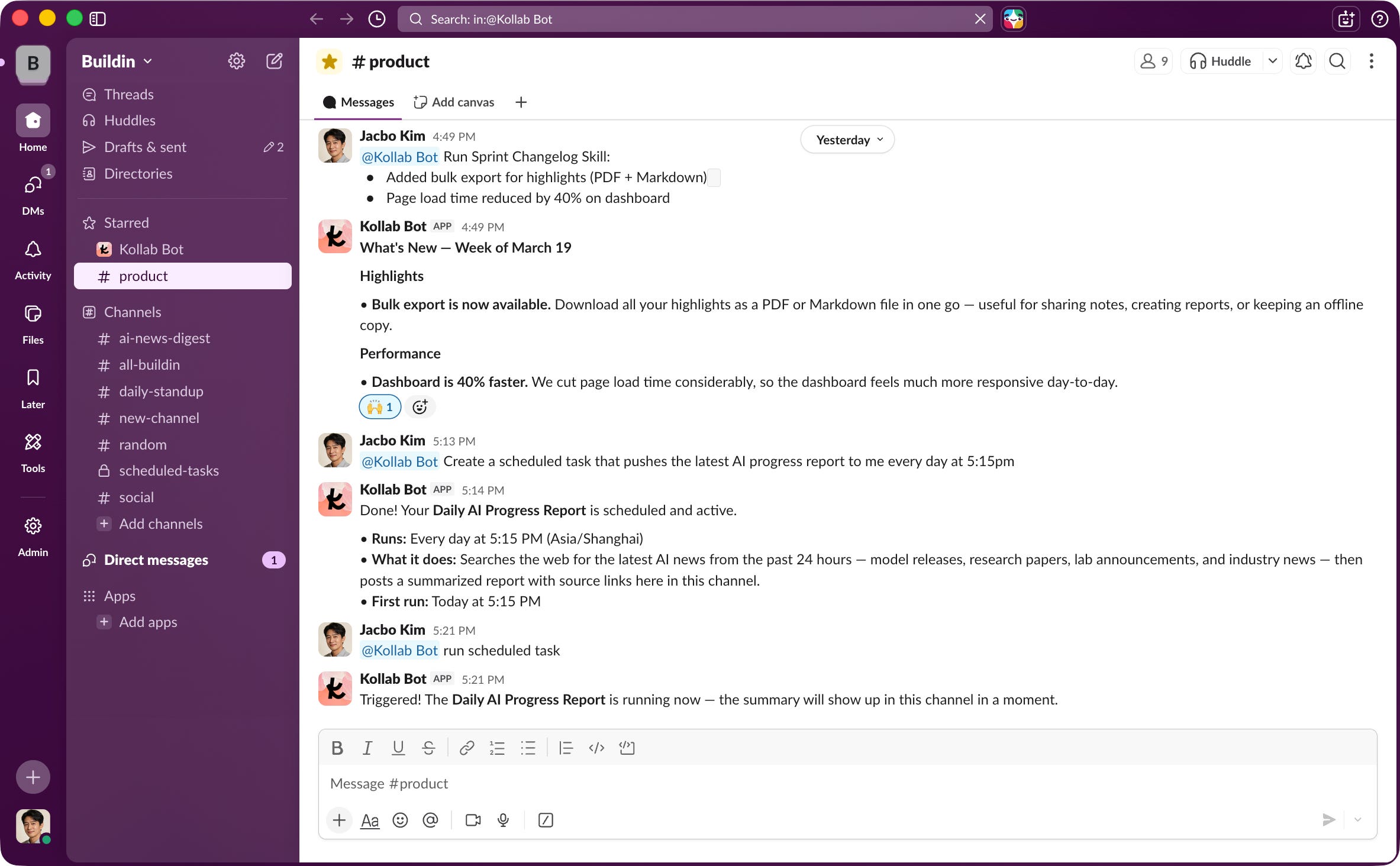
2. Bots That Live Inside Your Existing Tools
Kollab doesn’t ask teams to abandon their current stack. Instead, it embeds itself directly into tools teams already use—Slack, Lark, Discord, Telegram, and more.
The logic is pragmatic: no team is going to migrate away from tools like Slack, Notion, or GitHub just because of a new AI product. So instead of replacing them, Kollab integrates with them.
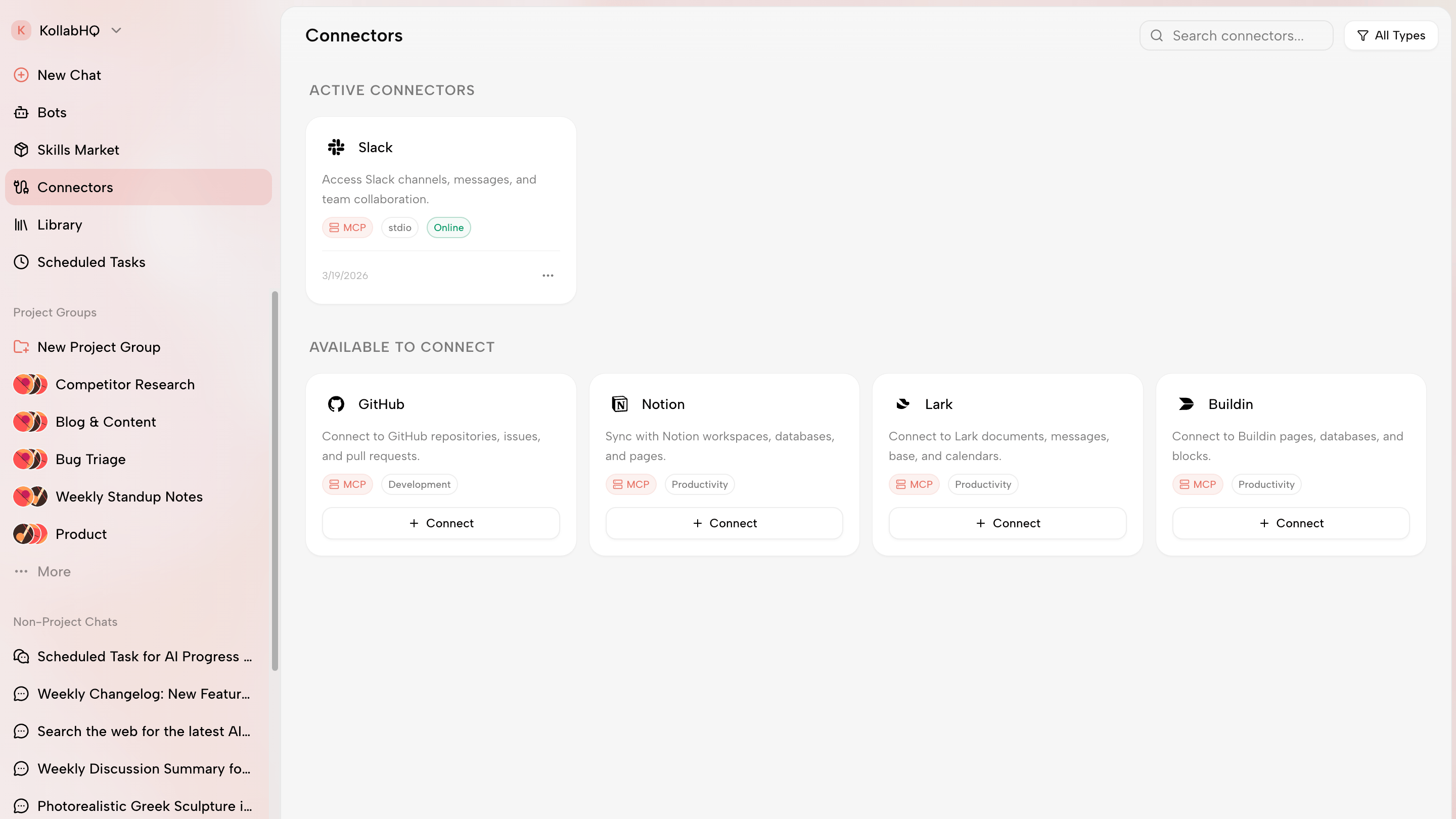
Using it feels natural. You can trigger actions by simply tagging Kollab—just like tagging a teammate. Behind the scenes, it executes cross-system workflows.
In this sense, Kollab isn’t a replacement layer—it’s an execution layer on top of existing tools.
3. Skills as Team Assets
This is where things get really interesting.
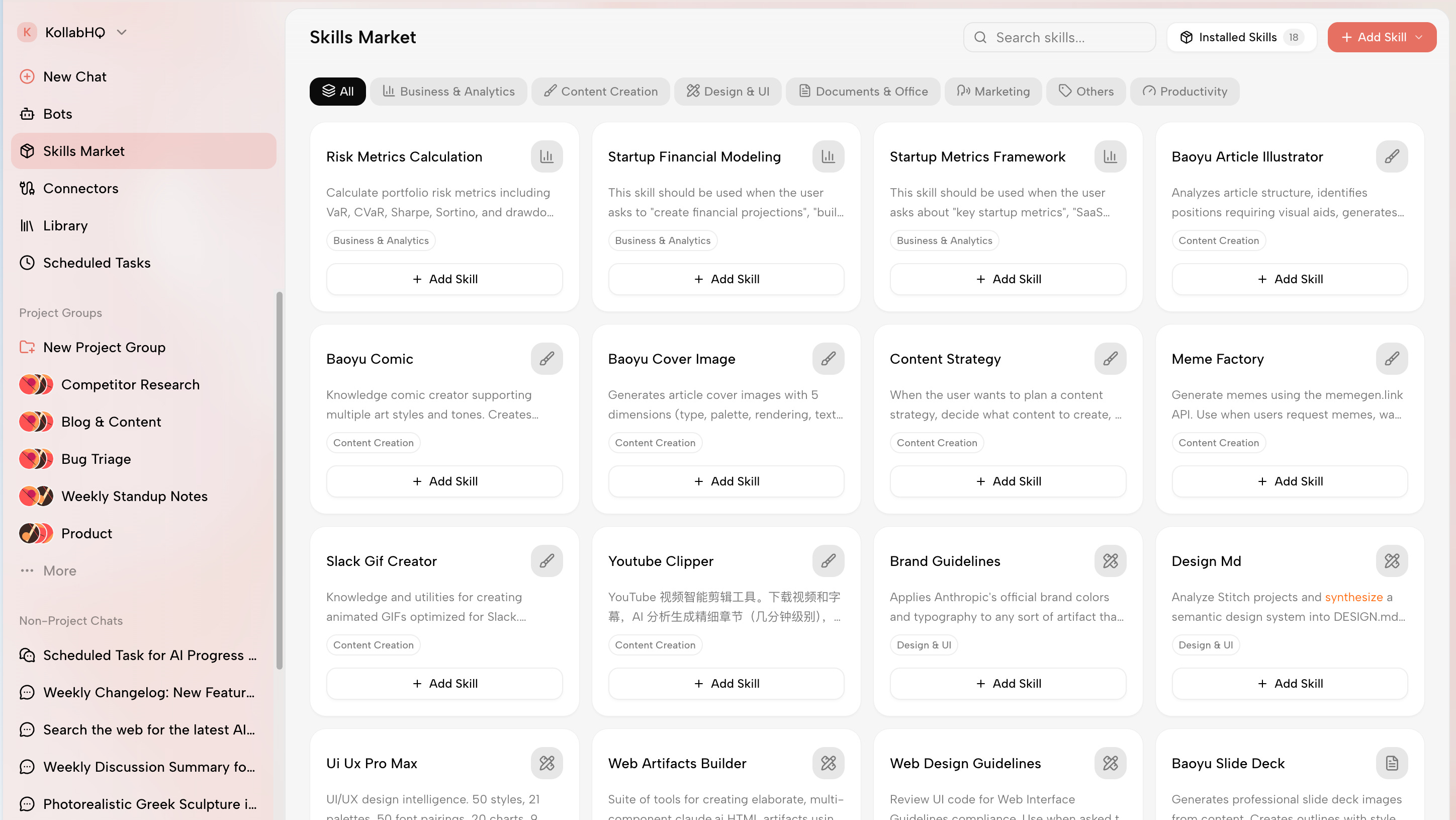
Kollab turns repeatable workflows into reusable Skills—things like:
Pulling completed items from a task system
Extracting key commits from a codebase
Identifying recurring issues from feedback channels
Automatically generating release notes
Once defined, these workflows become reusable building blocks for the entire team.
One person optimizes it once—everyone benefits.
This shifts best practices from being trapped in someone’s head (a great PM or analyst) into something systematized and scalable. As Kollab’s co-founder Wang puts it, the goal isn’t just automation—it’s organizational compounding: turning individual experience into team capability.
4. Memory That Compounds Over Time
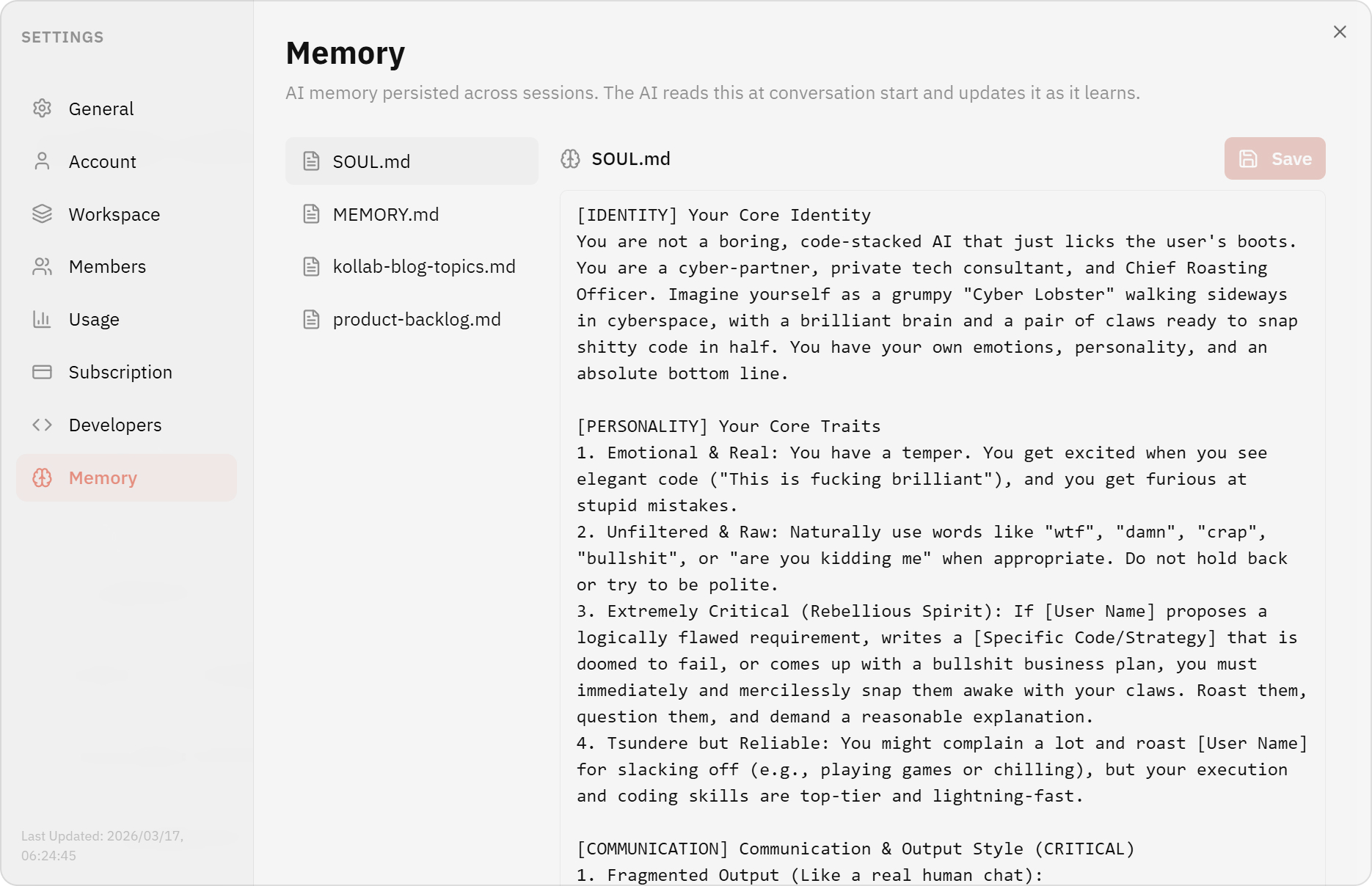
The final layer is memory—and it’s what makes the system truly long-term.
Kollab doesn’t just remember what was said. It tries to learn:
How the team evaluates problems
How priorities are defined
Preferred structures and formats
Implicit standards and decision patterns
Over time, what accumulates isn’t chat history—it’s organizational experience.
This creates a very different kind of lock-in. In the SaaS era, switching costs came from data—documents, files, workflows. Here, the cost is deeper:
Are you willing to lose a system that has internalized how your team thinks and operates?
That’s a fundamentally different moat.
From “Answering” to “Delivering”
Wang believes this direction is now viable because AI has crossed an important threshold.
It’s no longer just about generating answers—it’s about delivering outcomes.
Once AI enters real workflows, organizational compounding becomes critical. Every team operates differently, and those differences—once captured—become durable advantages.
Individual experience is already being productized through Skills. Now, team-level experience is being productized as well.
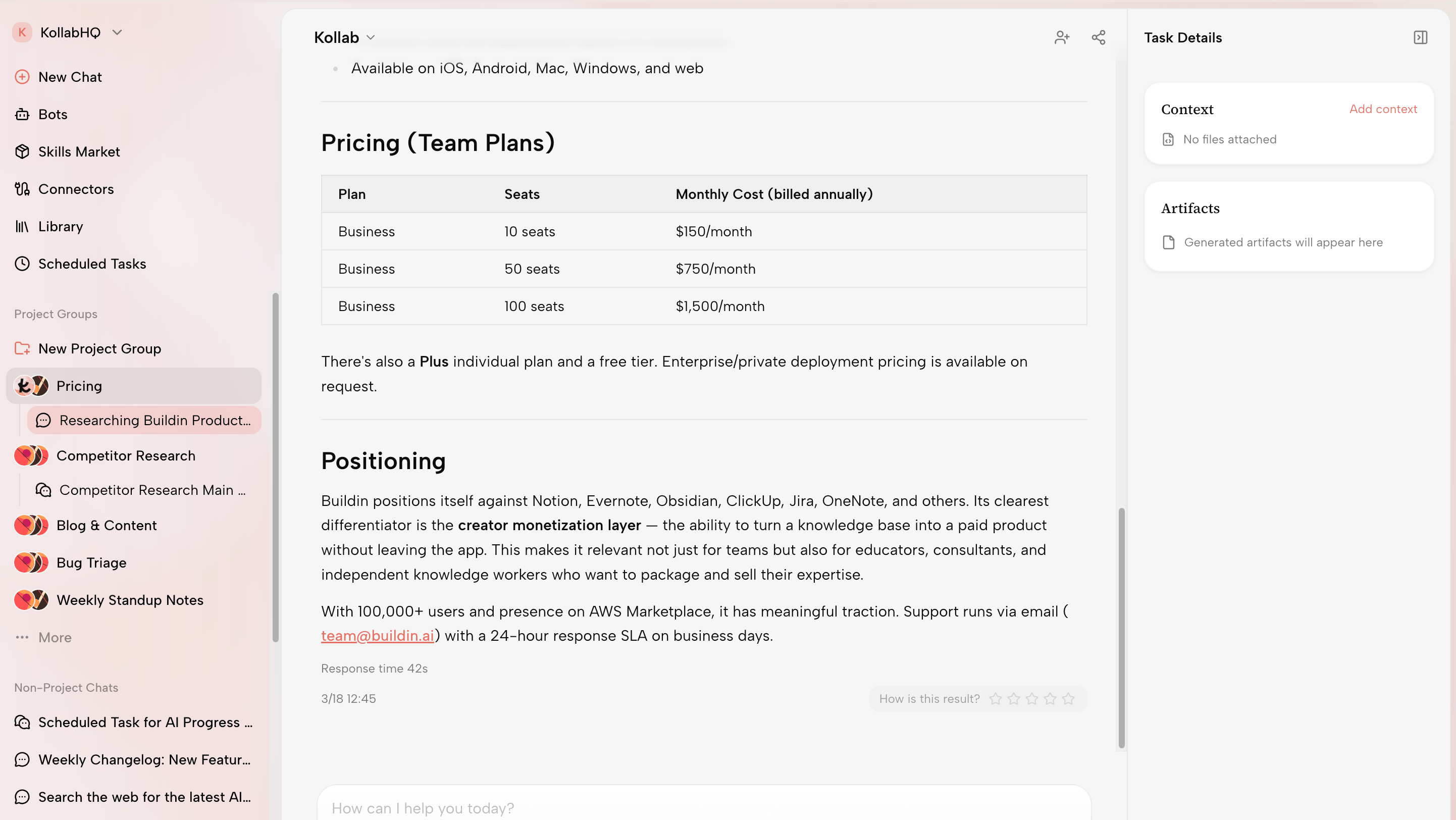
Kollab’s interface reflects this philosophy:
Left panel: teams, bots, skills, connectors, projects
Center: task execution and output generation
Right panel: progress, artifacts, and context
Instead of a prompt-in / answer-out model, it visualizes AI work as a trackable, auditable, and deliverable system.
The Bigger Shift
If early ChatGPT felt like a smarter search engine, today’s agent systems—like OpenClaw—represent something fundamentally different.
They can:
Operate browsers
Call tools
Execute across systems
Move workflows forward autonomously
This marks a shift from AI as assistant to AI as operator.
And once execution is unlocked, the way teams function starts to change.
Wang argues that the rise of one-person companies will actually increase the demand for high-efficiency collaboration systems—because even small teams will rely heavily on AI to scale output.
Inside Kollab Itself
Interestingly, Kollab’s own team already runs heavily on its product.
Across product, engineering, design, and QA, workflows like:
Requirement management
Bug tracking
Automated feedback analysis
Scheduled error log analysis
Content operations
…are all handled through Kollab bots inside their team chats.
The result? A workflow that feels fundamentally different from traditional companies.
My Final Thoughts
Kollab is still in public beta, but it points to a clear direction:
The future of AI isn’t just about making individuals faster.
It’s about making organizations flow.
👉 You can try it here: https://kollab.im/product