
Notion ARR hit $600M, Sequoia’s Investment playbook and Its Secret Weapon
Why a16z Is Quietly Betting on a New Kind of AI Learning

Notion ARR Hit $600M
Notion, the all-in-one AI-enhanced productivity workspace used by teams and individuals worldwide, has achieved an ARR of $600M, half of which comes from AI, and it is cash flow positive.
Recent enhancements—including customizable AI agents and generative AI tools capable of automating routine documentation and workflow tasks—have significantly increased user engagement and ARPU, especially in enterprise tiers.
Forbes said the company is considering multiple rounds of financing in quick succession leading up to an IPO. And Notion told its employees that they can sell some of their shares at an $11 billion valuation ahead of a potential initial public offering.
Sequoia’s Investment playbook and Its Secret Weaponand It’s Used for Over a Decade
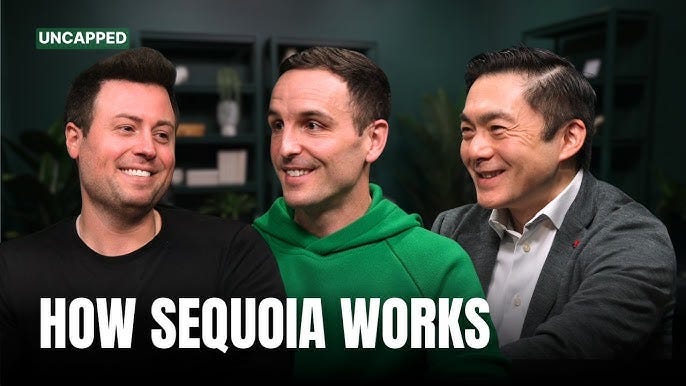
After Roelof Botha stepped down as Sequoia Capital’s global steward, the firm entered a new chapter led jointly by Alfred Lin and Pat Grady. The two recently sat down with Jack Altman—Sam Altman’s brother—for a wide-ranging conversation.
What they shared wasn’t just a retrospective on Sequoia’s culture. It was a rare look into how one of the most successful venture firms in history actually makes decisions—and why many of the instincts that feel “right” in traditional organizations are exactly the wrong ones in venture capital.
More interestingly, they revealed an internal system Sequoia has quietly refined for more than ten years—one that has become a structural advantage few outsiders ever see. Here are my learnings:
1. Consensus Is Useless. Conviction Is Everything.
In most organizations, “consensus” is treated as a sign of health and correctness. At Sequoia, they’ve come to believe the opposite.
Venture capital is a business of outliers. And in an outlier business, heat generated by strong opposing beliefs matters far more than lukewarm agreement.
For over a decade, Sequoia has used an internal voting system to support investment decisions. Partners score deals from 0 to 10—there is no 5. Scores of 6 or above count as “yes,” 4 or below as “no.”
After analyzing more than ten years of this data, Sequoia reached a counterintuitive conclusion: whether a deal had consensus at decision time had no correlation with eventual success.
What mattered was conviction.
Strong “yes” and strong “no” both matter. A deal where everyone votes 6 technically has consensus—but often lacks a single person who truly believes in it. By contrast, a deal with three 9s and three 1s, while deeply divisive, is often more interesting. Those three 9s represent real conviction—and conviction is the only reliable signal of asymmetric outcomes.
Extreme disagreement signals volatility. And venture capital is fundamentally a business that embraces volatility. A top-tier VC firm must be structurally designed to absorb the losses implied by the “1s,” in order to capture the upside created by the “9s.”
As Alfred Lin and Pat Grady put it:
Consensus versus non-consensus doesn’t matter at all. The only thing that matters is whether conviction exists. If three people are at 9 and three are at 1, that’s probably a deal worth doing.
2. Don’t Be a CEO Who Optimizes for Consistency—Be a Steward Who Empowers Outliers
Most CEOs optimize for consistency: delivering reliable, scalable quality. Venture capital is the opposite.
Pat Grady describes it as an “outlier business.” The goal isn’t to produce good companies reliably—it’s to find the two or three companies, out of thousands, that define the future.
To invest in outlier companies, you need outlier people. And managing outliers doesn’t work through top-down command and control.
At Sequoia, partners describe their role not as managers, but as stewards. Their job isn’t to tell people what to do—it’s to find exceptional talent and then get out of the way. Leadership means removing obstacles, providing support, and creating conditions where unique talent can fully express itself.
This doesn’t mean chaos. Sequoia believes in “freedom within frameworks.” Outliers aren’t left unbounded; they operate within a strong structure built on shared values, clear expectations of excellence, and high-quality processes. Within that framework, each individual works in their own way—maximizing personal strengths and increasing the odds of discovering the next outlier.
3. Stop Measuring Outputs. Focus on Controllable Inputs.
In venture capital, measuring outputs is not just difficult—it’s often misleading.
The true outcome of an investment may not be visible for a decade or more. Short-term signals like valuation markups are often mirages, not reflections of real value.
So Sequoia deliberately shifts attention away from uncontrollable outputs and toward controllable inputs, across three dimensions:
1) Values & Behaviors
For example, Sequoia’s growth team evaluates behavior based on four core values:
Aggressive but humble
Strong under scrutiny
High give-a-shit, zero bullshit
Demanding and supportive
(The last value was inspired by a partner named Gupta.) Team members are evaluated on how their behavior aligns with these principles.
2)Capabilities
The investment lifecycle is broken into five steps: sourcing, picking, winning, building, and harvesting. Partners are evaluated on their capabilities across each of these stages.
3)Process Quality
Sequoia cares more about how decisions are made than about superficial outcomes. For example, in deal selection, they focus on the quality of the investment memo—does it identify first-principles questions and demonstrate deep thinking? Length doesn’t matter.
Notably, Sequoia avoids individualized quantitative metrics altogether.
Pat Grady shared an early experience at Summit Partners to explain why. As a competitive 21-year-old, he optimized for weekly call quotas by calling founders he knew would answer—but would never raise capital. The metric encouraged performative behavior, not meaningful work.
Sequoia wants investors focused on a single goal: working with the most important founders of the future, not gaming short-term numbers.
4. The Art of Picking: Having the Courage to Look Stupid
A common misconception is that great investors should have lower failure rates. Sequoia’s data says otherwise.
One of Sequoia’s best-performing funds had a write-off rate close to 50%.
This reveals the real art of picking: success isn’t about minimizing failure—it’s about maintaining a high enough inclusion rate for asymmetric outcomes.
The rarest quality required is courage, in two forms:
Admitting mistakes and paying up.
After missing Snowflake early, Sequoia returned six months later at a much higher price, effectively asking for a second chance.
Holding conviction when no one else believes.
Sequoia backed companies like DoorDash and Zoom before consensus existed.
Doing something everyone thinks is stupid feels terrible. Your partners disagree. Other investors don’t think you’re “lovably wrong”—they think you’re incompetent. You have to endure that.
To manage this psychological pressure, Sequoia institutionalized reflection. They found most bad decisions weren’t calculation errors, but emotional traps—especially FOMO and fear of looking stupid.
They use internal checklists—like “separation of church and state”—to prevent emotional excitement from contaminating rational decision-making.
5. Sequoia’s Quiet Superpower: A PageRank System for Talent
During the conversation, they revealed a powerful, non-public competitive advantage: a proprietary data asset built continuously for over a decade.
Its core idea can be summarized as “PageRank for people.”
Through its investors and talent team, Sequoia systematically asks top performers in its network—say, a great VP of Engineering—one simple question:
“Who are the five smartest, most respected peers you know?”
By collecting, tracking, and updating these answers for over ten years, Sequoia has built a living map of Silicon Valley’s talent flows. The system helps them identify future founders early—and quickly assess the quality of teams inside scaling companies.
Crucially, this system only works because it’s not transactional. You must give value first. Trust precedes information.
Why a16z Is Quietly Betting on a New Kind of AI Learning
Everything above explains how elite VCs think: why conviction beats consensus, how outliers are empowered, and how invisible systems create long-term edge.
What follows is a concrete case study—a recently funded AI learning startup that rejects tutors, chatbots, and Q&A, and instead builds something more fundamental: a real learning path.
