
"Manus + n8n", Bika is building The World’s First AI Organizer
AI manager for one-person companies

AI products are multiplying, and their capabilities are getting stronger. Yet somehow, we don’t feel more relaxed—we’re busier than ever. We’re constantly switching between different AI tools, writing prompts, and making endless tweaks.
That’s why automation has become the core value proposition of many AI products today.
Tools like n8n, Clay, and AI CRM Attio (which raised over $100M,) all share one key component: automation. Once AI unlocks and connects the data, automation supercharges workflow efficiency.

“AI + automation” is becoming the new default. The founder of n8n once said that after introducing AI into their automation workflows, their revenue grew 5x.
Still, most automation today focuses on relatively simple workflows. If we want to bring automation into the complex management and collaboration processes of entire teams, then the long-awaited explosion of one-person companies might arrive much faster.
AI manager for one-person companies
This is exactly what Bika.ai is working on. From an enterprise management perspective, they’ve introduced a new concept: the AI Organizer—a role designed to organize and manage different AI Agents to achieve true coordination.
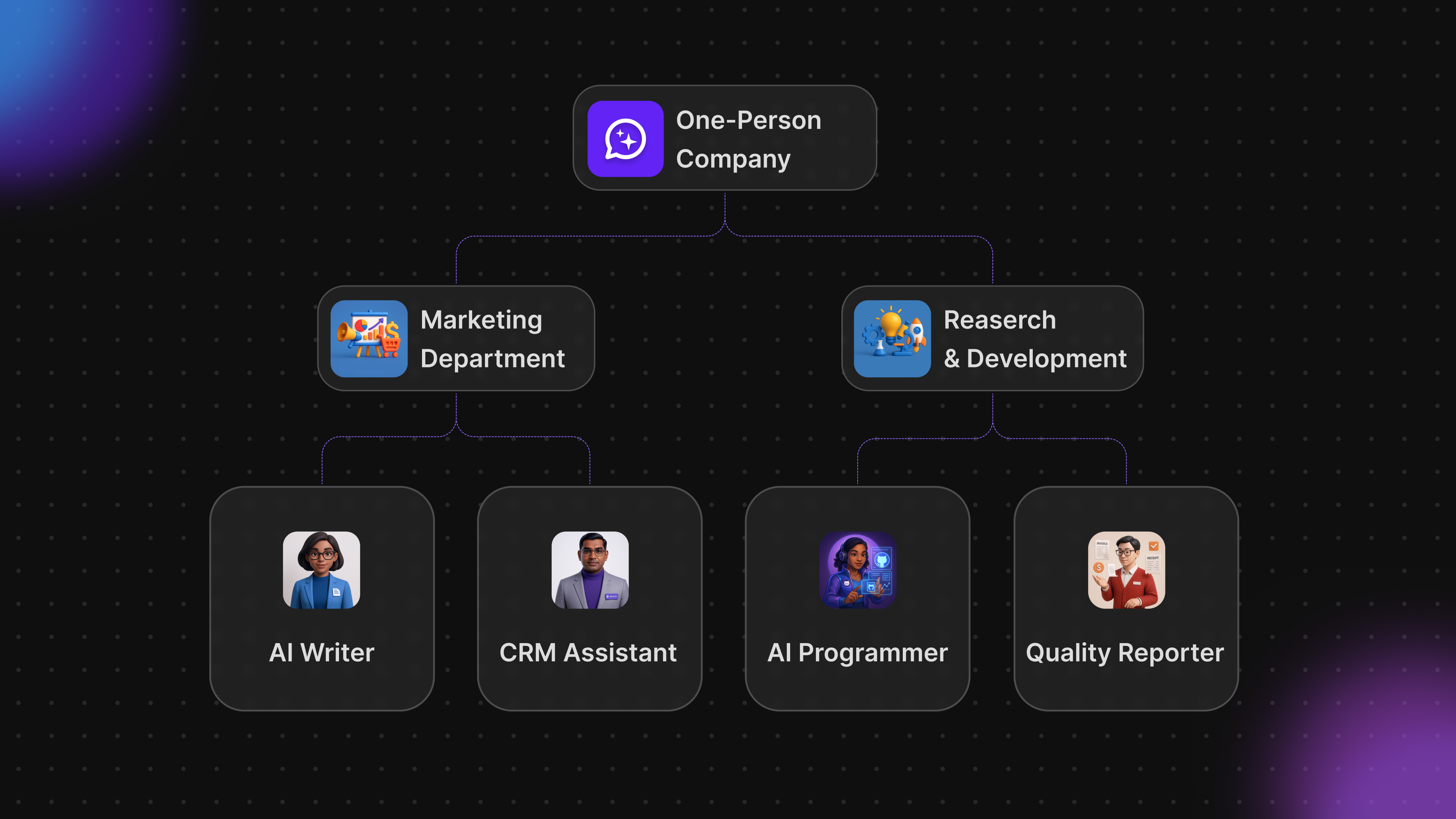
The problem is clear here: AI tools solve single-point problems, but they create new management burdens. Too many tools, too fragmented, too expensive—humans end up being the busiest “cogs” in the system.
It’s very similar to the history of industrialization. Machines improved single-task efficiency, but real transformation came from management systems.
Productivity exploded only when machines, energy, and workers were connected into standardized assembly lines.
AI tools are in the same position: each is strong individually, but without a “conductor” to set goals, divide tasks, and supervise execution, overall efficiency is capped.
In the AI era, the real shortage isn’t execution—it’s organization. That’s why Bika hopes the AI Organizer can fill this gap.
Right now, it’s positioned as an AI manager for one-person companies. If AI tools (Agents) are the factory workers, then Bika isn’t building more workers—it’s building the manager.
The product goes beyond just providing Agent capabilities. Its real focus is turning scattered Agents into a functioning team. Users can act like CEOs—set the goals—and let their AI team handle execution.
I’d compare it to Manus + n8n: it provides foundations like Agent building, automation, databases, and dashboards, but layers on an AI manager role that integrates everything into one collaborative system.
It can understand objectives, assign tasks, unify feedback, and ensure smooth flow from input to output. In other words, it’s both a manager and a hub.
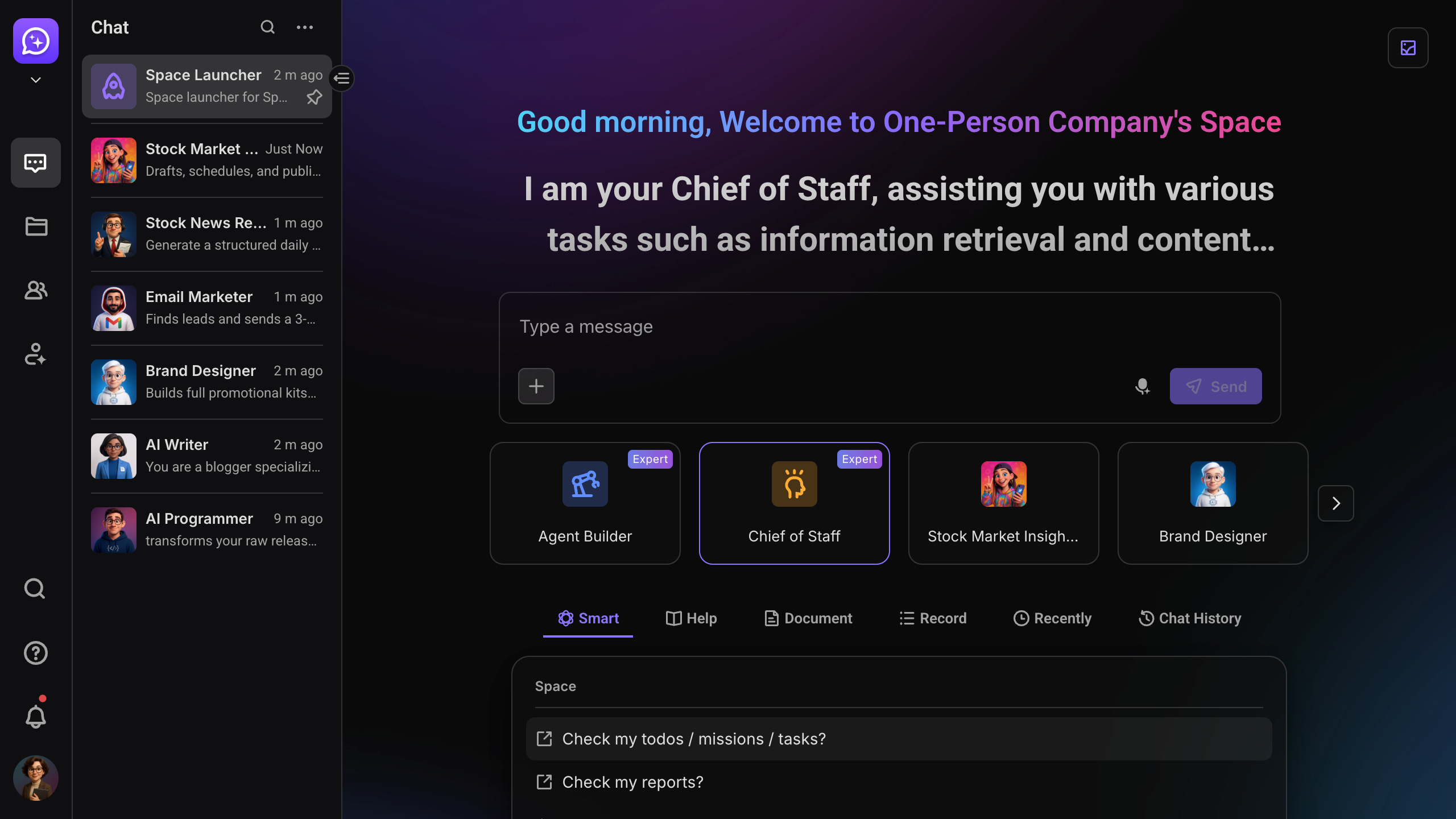
Interaction works like most Agent products—chat-based conversations—but the implementation is different. Bika introduces three roles:
Agent Builder – lets you create new Agents.
Chief of Staff – coordinates other Agents, like a general manager.
Single Agent – handles a specific task.
Clear target users
Bika is starting with simple organizations:
Solo founders / one-person companies who want AI to replace repetitive workflows.
Freelancers & creative professionals (finance bloggers, brand designers, marketing consultants) who need automated client management.
Digital creators running courses, communities, or subscription businesses.
AI automation hobbyists migrating from Zapier/Make.com, seeking lower barriers and higher integration.
Extended users include remote teams, no-code builders, and lean startups.
One finance blogger, for instance, now charges five figures per client each month thanks to a Bika-powered “AI automation workflow.”
Every morning, the system fetches stock data from Futu and Alpha Vantage, feeds it into AI to generate a PPT and market insights, and delivers it for him to review and send.
Here, AI doesn’t replace him—it lightens repetitive work so he can focus on emotional value, trust, and higher-level services.
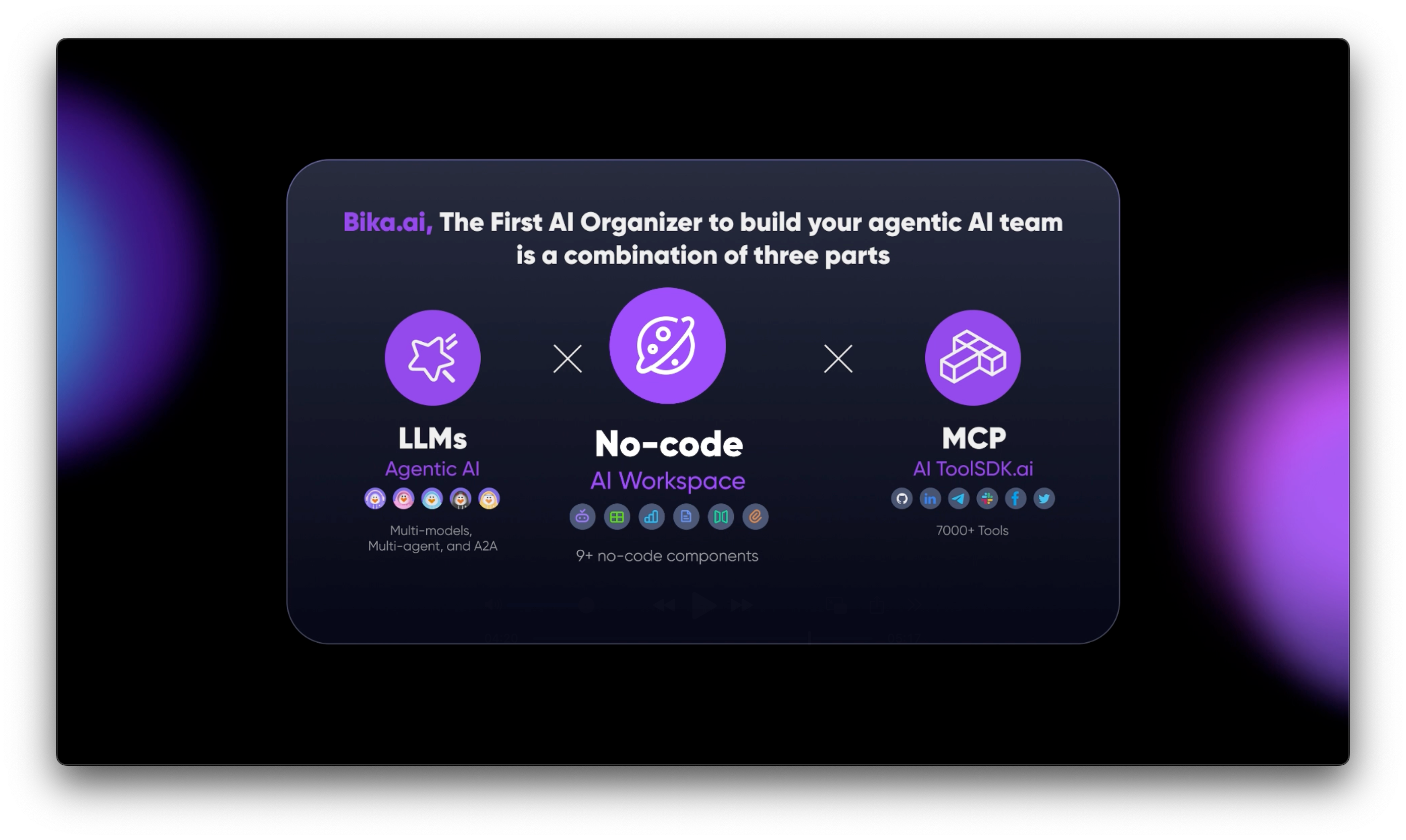
To lower the barrier, Bika comes with 100+ industry templates, essentially ready-made SOPs across marketing, sales, content, and ops.
Their in-house ToolSDK.ai has integrated 5,000+ MCP tools (email, payments, CRM, cloud). That means AI doesn’t just answer—it can actually run your workflows end-to-end.
Take Sales Contract Automation Management as an example: SMBs often struggle with contract renewals and receivables tracking.
Traditionally, it’s endless spreadsheets and email reminders—slow and error-prone. With Bika, a template handles it automatically: every Monday, the system generates a 30-day expiring contract report, creates an accounts receivable list, and pushes it to the team. Contract details, client data, invoices, and payment plans stay synced in one dashboard. Finance staff only update real payment statuses—the system does the rest.
If no template exists, you can build one via Agent Builder. That’s why I think Bika isn’t just “another tool.” It’s trying to elevate AI from worker → manager, effectively defining a new category: AI Organizer.
From tools to management
Bika’s DNA is rooted in management thinking. Founder Kelly and the core team previously built Vika, one of China’s first multidimensional spreadsheet products, inspired by real pain points in managing HeyTea’s retail stores. In his words:
We’re not building tools. We’re using technology to solve management problems.
The journey hasn’t been smooth. Management is inherently complex, and in product form that means lots of heavy features—overwhelming for first-time users. But once users unlock the power, retention could be very strong.
Bika has already repositioned three times:
Started as a “Big Data Multidimensional Spreadsheet” (too heavy, high learning cost).
Added automation (users compared it to n8n/Zapier).
Added templates (still confusing—too many options).
Finally, simplified into “AI Organizer”—focus on what you can do, not how it works.
This shift solved two key pain points:
Where does the data come from? No need for APIs—system pulls Twitter, LinkedIn, stock data, and even posts to TikTok.
Is automation hard? No coding—just pick an Agent template and run (like the finance blogger’s data → insights → client flow).
The positioning is smart: easier than n8n (no coding), more flexible than Zapier (5,000 integrations, cheaper), lighter than Airtable (no table setup required).
And since data sourcing is often the hardest part, solving it lowers the barrier dramatically.
Now, Bika has tens of thousands of overseas users, many paying—mainly for niche, specific scenarios. The team remains lean at ~20 people, with Vika now serving as Bika’s infrastructure layer. As Kelly put it:
The industrial revolution solved repetitive labor for blue-collar workers. AI should do the same for white-collar workers.
Bika aims to deliver not another Super Agent, but a Super Organizer—solving coordination, not just execution.
That’s a shift from tools → organizations. Traditional tools solve fragments (docs, spreadsheets, workflows), leaving humans to stitch them together.
Bika flips the model: it first builds an organizational framework, then inserts Agents and tools. Users just describe goals—the AI team decomposes and executes. You’re no longer a “prompt middleman,” but a true CEO.
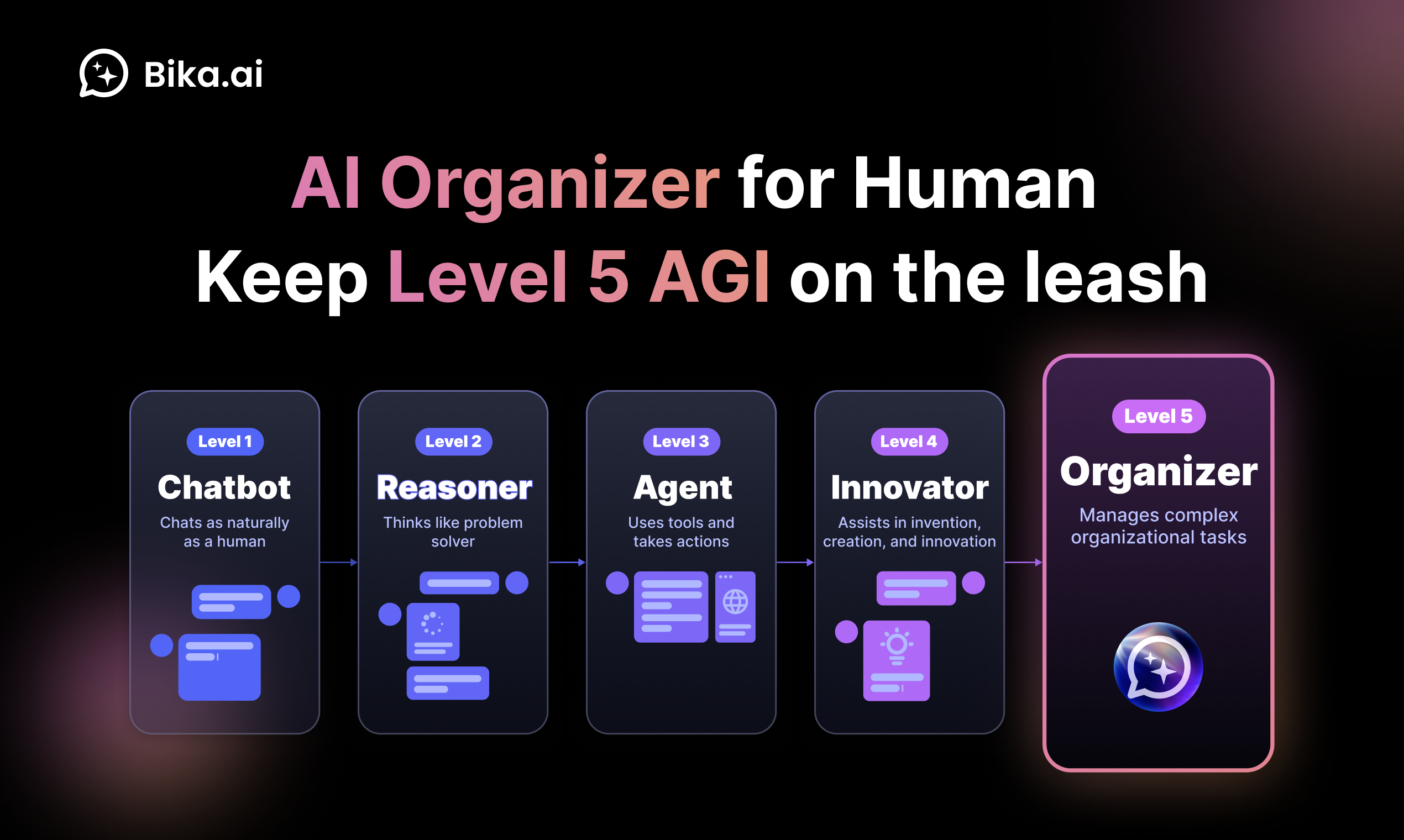
In OpenAI’s five-level AGI model—Chatbots → Reasoners → Agents → Innovators → Organizers—Bika jumps straight to Level 5: Organizers. It’s the first product I’ve seen approach AI from this perspective, and it’s a fascinating attempt.
Recent big funding rounds for You.com and Exa show that building for AI Agents—not humans—will be a critical frontier.

As goes search, so goes management: the future of both is AI-Agent-centric.
That’s why I believe Bika’s exploration as an AI Organizer is not only ahead of the curve—but also very meaningful.