
Lovable ARR Hit $400M, Service as Software and the AI Career Agent's 20x growth in 5 months
Conversation with AI is far more powerful than simple algorithmic matching

Lovable ARR Hit $400M from $300M in 1 month
The Vibe Coding war is still on. While Base44 hit $100M ARR in a year of launch, Cursor reportedly hit $2B ARR.
Now Lovable’s business growth has been equally explosive. The company recently announced that its annual recurring revenue (ARR) has reached $400M, jumping from $300M just one month earlier and effectively doubling in only a few months.

That is saying Lovable is one of the fast-growing AI coding platforms that enables users to build full-stack applications and websites simply by describing what they want in natural language.
Founded in Stockholm by Anton Osika and Fabian Hedin, the company popularized the concept of “vibe coding”—a workflow where AI generates and iterates on code based on conversational prompts.
The platform’s adoption has surged as AI-assisted development becomes mainstream. Lovable now reports around 15 million daily active users and sees over 200,000 new projects created every day, indicating massive demand for AI-powered development tools across both individuals and businesses.
It has raised major venture funding, including a $330 million Series B round led by CapitalG and Menlo Ventures, bringing its valuation to about $6.6 billion. With this momentum, Lovable is projecting that it could surpass $1 billion ARR in the near future, positioning itself as one of the defining companies in the emerging AI coding infrastructure market.
Services As Software
Sequoia’s Julien Bek published an insightful article Services: The New Software, " which argues that the next generation of massive tech companies will not sell software tools, but rather the outcomes traditionally provided by human service firms.
The Core Shift is From Tools to Work
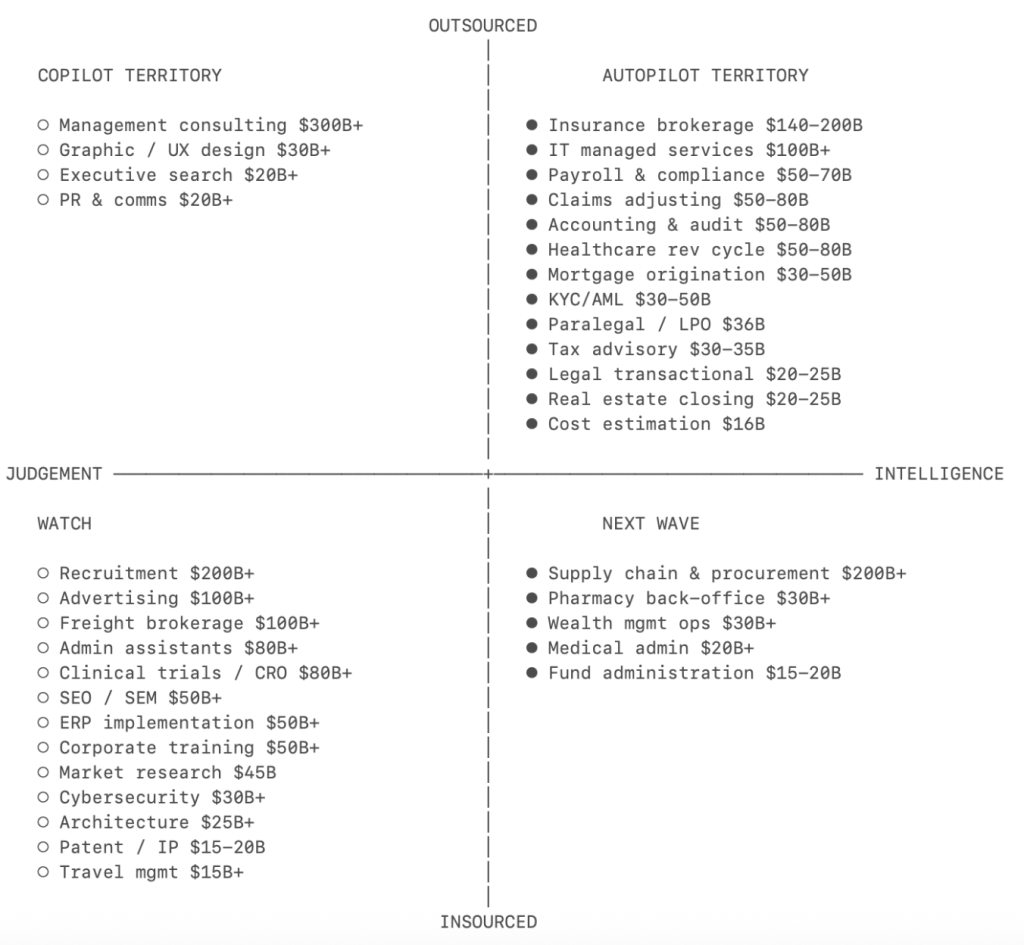
Julien posits that the “Copilot” era (selling tools to professionals) is transitioning into the “Autopilot” era (selling the finished work).
The Risk: If you sell a tool, you are in a race against AI model improvements that might turn your product into a “feature.”
The Opportunity: If you sell the work, every AI improvement makes your service faster and more profitable.
Intelligence vs. Judgement
He distinguishes between two types of labor to identify where AI will win first:
Intelligence: Tasks involving rules, translation, and processing (e.g., writing code, medical coding, filling forms). AI has already crossed the threshold to handle these autonomously.
Judgement: Tasks requiring experience, instinct, and “taste” (e.g., deciding which feature to build, cultural fit in hiring).
The Trend: Today’s “judgement” will become tomorrow’s “intelligence” as models accumulate proprietary data.
The “Outsourcing” Wedge
The most effective way for “Autopilot” startups to enter the market is to target tasks that are already outsourced. This is effective because the company already accepts that the work is done externally.
There is an established budget line for the work. And the buyer is already purchasing a specific outcome rather than managing headcount.
High-Opportunity Verticals
Julien maps out several multi-billion dollar markets ripe for AI-native services:
Accounting/Audit: Facing a massive talent shortage, AI can “close the books” directly.
Insurance Brokerage: Highly standardized work that is currently fragmented across thousands of human brokers.
Healthcare Revenue Cycle: Medical coding is a “pure intelligence” task with mature outsourcing.
Legal/Transactional: Standardized work like NDAs and contract drafting where quality is easily verifiable.
For founders, the “Innovator’s Dilemma” is now: will you continue selling tools to your customers, or will you replace your customers’ manual labor entirely? Sequoia suggests that the most legendary companies of the next decade will choose the latter.
2 Cases of the Trend: AI Recruiting Platform/AI Career Agent grows at 20x+ in 6 months
AI Career Agent is one of the cases of Services As Software trend. One example is Juicebox, an AI recruiting startup backed by Sequoia Capital in the U.S. With only a small team of a few people, it has already surpassed $10 million in ARR, growing revenue 10× within a year.

Today it announced an $80M Series B at an $850M valuation, led by DST Global, with participation from Sequoia Capital, Coatue, and Y Combinator.
Although recruiting is currently its core business, the company is already expanding the model into other areas — such as sales lead generation and market research.
At its core, the model depends on one thing: how effectively AI can gather large volumes of accurate information and use it for precise matching.
Traditionally, most recruiting platforms relied on pulling data from sources like LinkedIn and other databases across the web.
Two AI Agents Replacing the Traditional Headhunter
Another example entering the recruiting space has taken a much simpler and more direct approach. Instead of relying primarily on external data scraping, it gathers information through conversation — letting users interact directly with an AI agent.
This design significantly improves both efficiency and accuracy, grows its revenue 20x+ in 6 months.
