
How Clawdbot was Built, the AI OnlyFans hit $100M in ARR
Redis ARR hit $300M

Redis ARR Hit $300M
Redis, the popular in-memory data platform trusted by developers worldwide, has officially surpassed $300M in ARR, marking a major milestone in its evolution from a high-performance cache into a multi-purpose real-time data infrastructure.
Originally known for lightning-fast key-value storage, Redis has expanded into a broader platform supporting caching, session storage, streaming, search, vector databases, and now AI-agent workloads, making it a foundational layer for modern cloud-native and AI-driven applications.
At its core, Redis solves the problem of speed and real-time data access at scale. By keeping data in memory and offering flexible data structures, Redis enables developers to dramatically reduce latency for applications such as recommendation systems, fraud detection, gaming leaderboards, messaging, and increasingly, LLM and AI agent state management.
How the overnight success of Clawdbot was Built
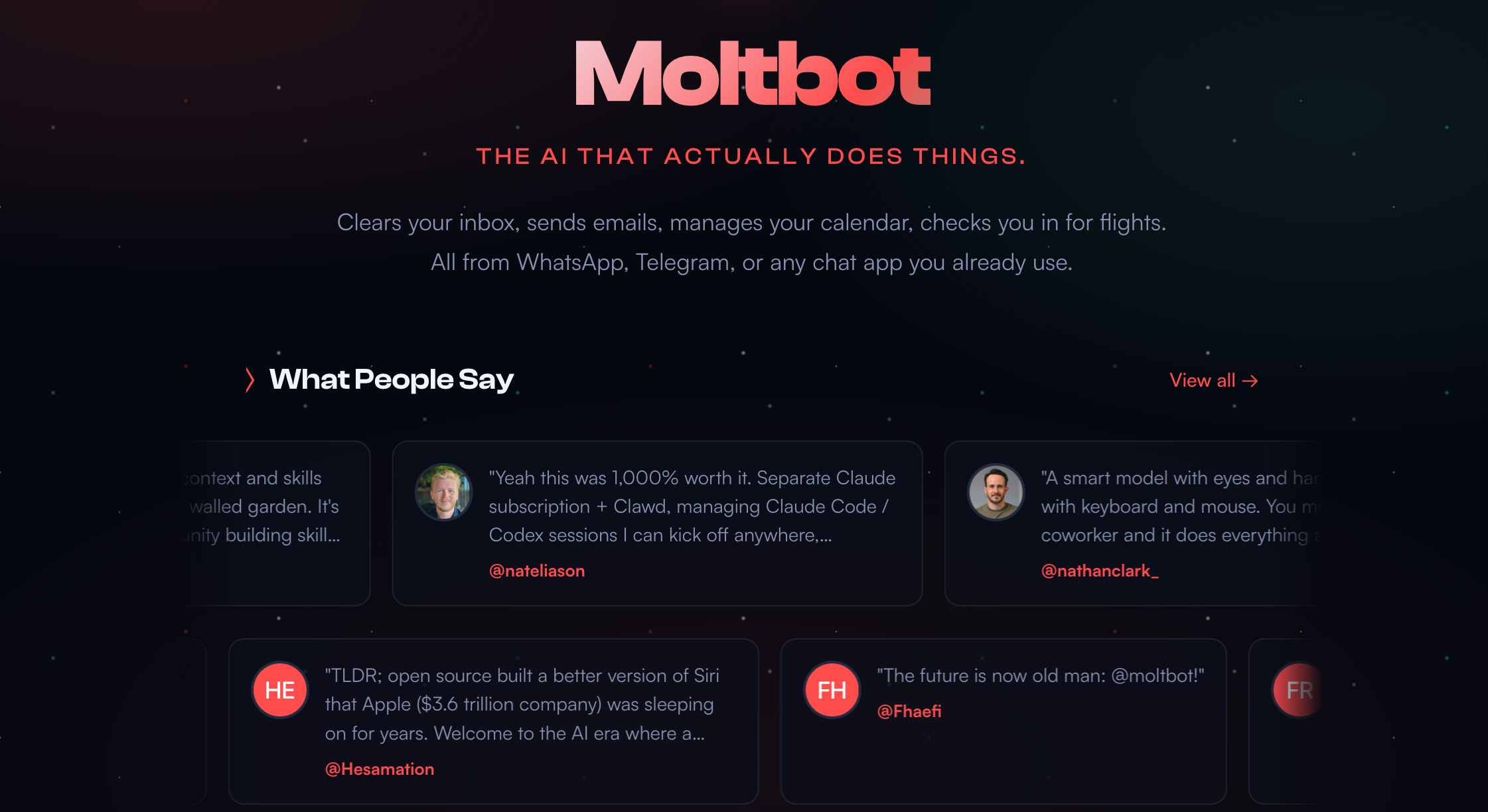
Over the past few weeks, Clawdbot — recently renamed Moltbot following a complaint from Anthropic — has exploded in popularity.
It is being described as one of the first real personal AI agents with “Jarvis-level” capabilities.
And for once, that description doesn’t feel like marketing hype.
Why Clawdbot Feels Different from Most AI Assistants
Most AI products today stop at conversation. Clawdbot doesn’t.
Its core value isn’t chatting — it’s execution.
Clawdbot is designed to act as a true digital butler, capable of automating tasks across applications and directly operating your device and accounts. It can:
Monitor flight statuses and complete online check-ins
Manage calendars and send messages via WhatsApp or other messaging apps
Execute local CLI commands: rename files, organize folders, write and run code
Control smart home devices like Sonos speakers
Because it can operate locally, Clawdbot blurs the line between software and human action.
The hype got so intense that:
Mac Mini sales reportedly surged, as developers began dedicating local machines to running Clawdbot
Cloudflare’s stock jumped ~14%, as investors noticed developers using its infrastructure to support local AI agents
Suddenly, “local-first AI agents” became investable again.
Not for Everyone — Yet
a16z partner Olivia Moore shared her thoughts after testing Clawdbot:
For developers and technical users, Clawdbot is an experimental playground with endless possibilities.
But for mainstream users, it’s probably not ready yet.
She pointed out three major frictions:
Security risks are hard for non-technical users to evaluate
Setup complexity is high
Most people don’t actually know what they want an agent like this to do
For most consumers, products like Claude Cowork may still be a better fit — at least for now.
An “Overnight Success” Built on 40+ Side Projects
Clawdbot’s sudden popularity also made its creator, Peter Steinberger, an overnight name in the AI world.
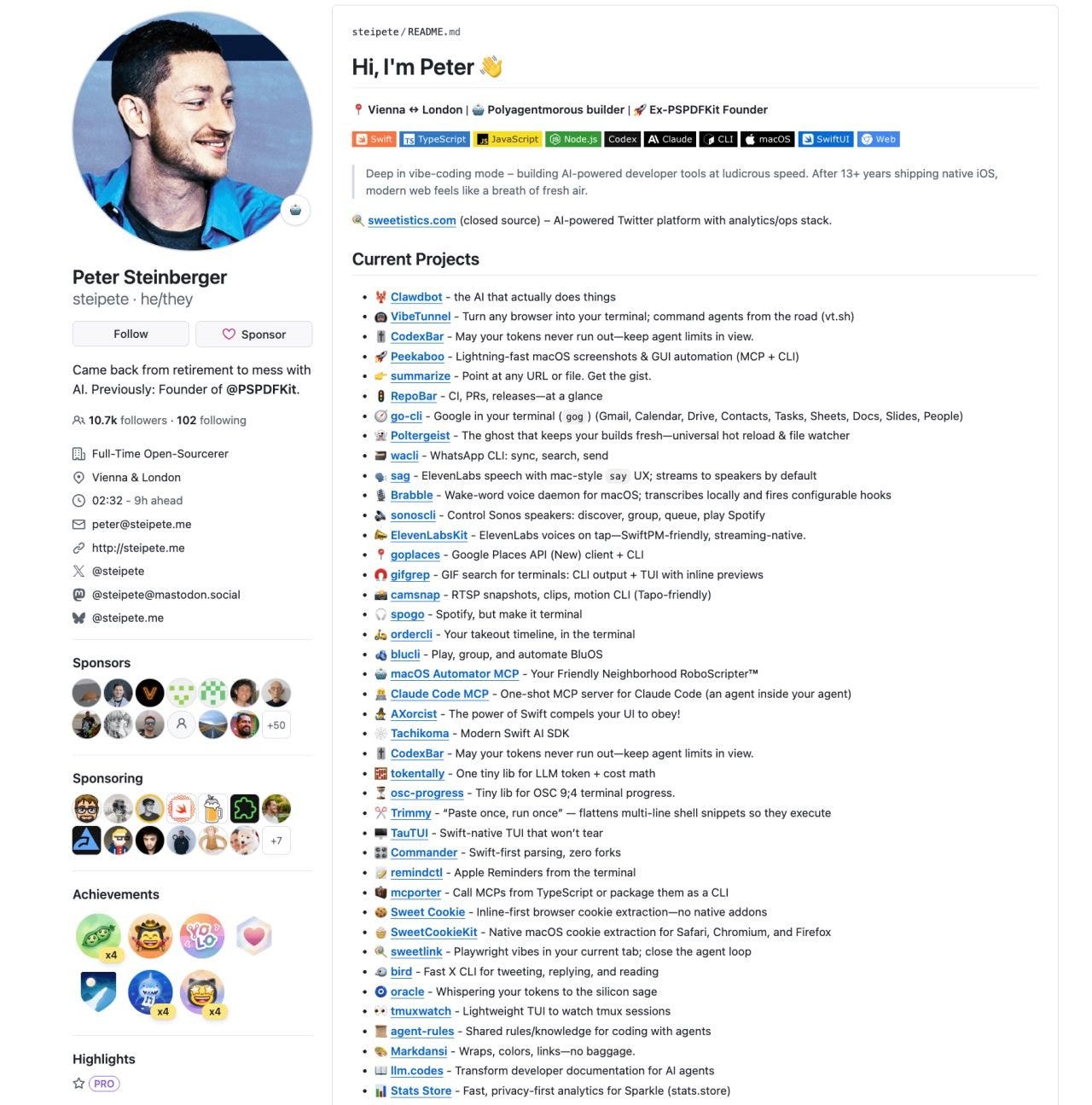
But if you look at his GitHub profile, the story feels very different.
Before Clawdbot, Peter had already built more than 40 products — mostly small tools. When people started reviewing those projects closely, a pattern emerged:
Clawdbot is essentially a wrapper that connects all of Peter’s previous work.
Rather than a single product, Peter is assembling an entire AI agent ecosystem.
Clawdbot as the “Brain”
At the center of this ecosystem is Clawdbot (now Moltbot) itself — not a chatbot, but an agentic AI.
All of Peter’s CLI tools and MCP servers ultimately connect to this “brain,” enabling the agent to perform real-world actions instead of just generating text.
Think of it this way:
Clawdbot = the brain
Everything else = hands, eyes, and nervous system
The “Hands”: CLI Tools for Action
Peter has built an extensive set of command-line tools that give Clawdbot concrete skills:
Social & Communication: bird for Twitter/X actions, imsg for iMessage, wacli for WhatsApp synchronization.
Life & Work: go-cli for Google Calendar, Docs, and Gmail; remindctl for Apple Reminders; ordercli for food delivery management.
Hardware Control: sonoscli for speakers; blucli for audio systems; camsnap for camera snapshots.
These tools allow Clawdbot to do things, not just suggest them.
The “Eyes”: Seeing and Understanding the UI
To operate a computer like a human, an AI must understand what’s on the screen.
Peter built that too. Peekaboo: Gives AI access to macOS screenshots and GUI automation, enabling visual Q&A over the current screen.
While AXorcist: Uses Swift-based UI control to precisely interact with apps that have no APIs — clicking buttons, navigating menus, controlling interfaces.
This is what turns a language model into an actual computer user.
The Infrastructure Layer
To make the brain and tools work seamlessly together, Peter also built middleware:
VibeTunnel: Enables remote control — you can issue commands to your home Clawdbot from a browser on the street.
mcporter: A core connector that lets TypeScript-based AI plugins behave like APIs or be packaged as CLIs.
SweetCookieKit: A deceptively powerful tool that allows AI to extract browser cookies automatically — solving authentication for protected sites like food delivery or banking portals.
Rewriting the Human–Computer Interface
It’s unlikely Peter started with a master plan like this. But in hindsight, his philosophy is clear:
a LEGO-style approach that turns every corner of macOS into an API an AI agent can call.
He’s not just building a product — he’s rebuilding the interface between humans and machines.
And Yes, He’d Already Made $100M+ Before
This isn’t Peter’s first success.
Before all of this, he sold a significant stake in PSPDFKit to Insight Partners for over €100 million.
After the exit, he openly wrote about feeling empty — traveling, doing therapy, searching for meaning. Eventually, he rediscovered that building things was what gave him the most joy.
That spark led to this entire ecosystem.
Most “overnight successes” look like this when you zoom out.
Meanwhile: The AI-OnlyFans That Quietly Hit $100M+ ARR
We all know how profitable OnlyFans is.
But AI created a new opening: what if OnlyFans itself became AI-native?
