
Higgsfield Run Rate hit $50M in 5 months[Update]
The AI Infra behind Higgsfield grow monthly revenue by 40x

Among the fastest-growing AI infrastructure products I’ve been tracking recently, two stand out in the realm of image and video generation. The explosive rise of AI Apps has also fueled their meteoric revenue growth.
Fal.ai surpassed $100M ARR, while another grew monthly revenue by 40x.

Now, Higgsfield has crossed the $100M ARR mark, and in an even shorter timeframe. Just two months after launch, it had already hit $11M ARR, with over 2M MAUs and peak DAUs of 600K.
Yesterday, Higgsfield announced a fresh $50M funding round, along with the milestone of surpassing $100M $50M ARR and 11M users—less than six months since launch.
【 Update: Higgsfield first announced they are the fastest $1M-$100M ARR, but a day later announced their Run-Rate hit $50M 】
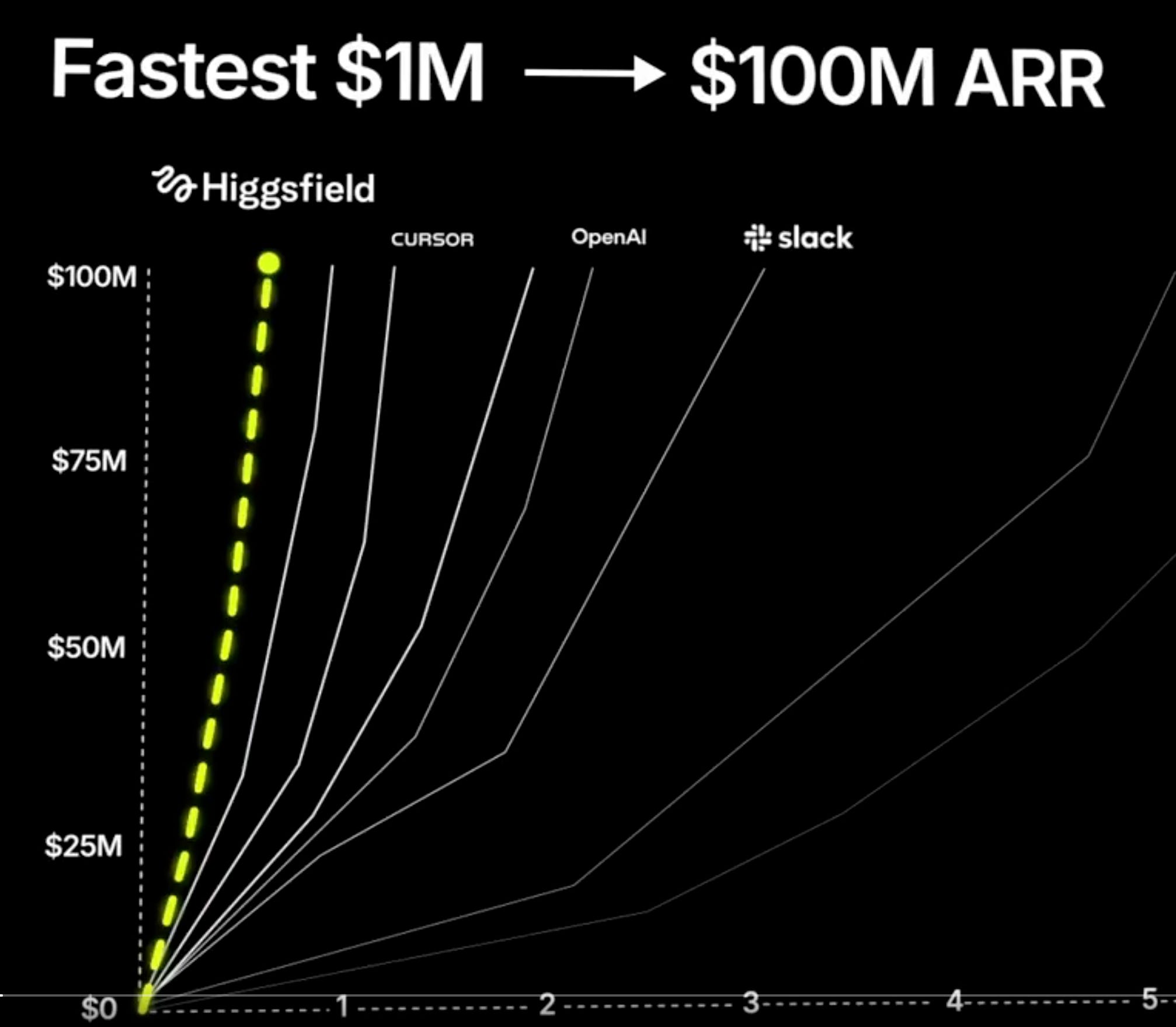
At the same time, the company unveiled Higgsfield Ventures, a $50M ecosystem fund aimed at backing the next wave of AI-native startups.
Higgsfield’s founder, Alex Mashrabov, brings a rich background. He was formerly Head of Generative AI at Snap, and before that co-founded AI Factory, which Snap acquired in 2020 for $166M. AI Factory was the team behind Snapchat’s viral Cameos feature.
At Snap, Mashrabov oversaw multiple generative AI products, including AR effects, filters, and the controversial MyAI chatbot, which became the world’s second-largest consumer AI chatbot with more than 150M users.
Higgsfield officially launched in April this year, reaching $11M ARR in just two months. The idea came from opportunities Mashrabov noticed at Snap. When OpenAI’s Sora shook the tech world, it was positioned primarily for well-funded creative professionals—not hobbyists or small marketing teams.
So Higgsfield set out to target a broader spectrum of creators—from everyday users making fun content with friends, to social media creators experimenting with new formats, to marketers trying to make brands stand out.
But the positioning went beyond being just a video generation tool. Higgsfield aims to build a “video reasoning engine”—a system capable of understanding and creating content with cinematic language. Co-founder Yerzat Dulat put it this way: they’re not just solving style problems, but structural problems.
What makes Higgsfield stand out to me is the remarkable realism of its generated videos. Every time I come across them on X, the lifelike quality is striking. Behind that realism lies a distinctive technical approach.

They’ve developed a diffusion transformer architecture that pushes the boundaries of visual realism, natural motion, and physics simulation. By combining latent diffusion with transformer architectures, and training on vast real-world datasets, Higgsfield is building one of the first “world models”—so realistic they can simulate the physical world.
Unlike text-to-video or image-to-video approaches, Higgsfield pioneered a new category: “click-to-video.” As they describe it: “While text-to-video and image-to-video rely on complex prompts, click-to-video replaces guesswork with simplicity: one click transforms curated presets into cinematic, brand-ready clips.”
Higgsfield’s $8M seed round was led by Amy Wu of Menlo Ventures, who described it as a category-creating company, arguing that video AI is approaching its “ChatGPT moment.” She also noted that the video generation market in the U.S. alone could be worth $200B.
The recent $50M Series A was led by Jeff Herbst of GFT Ventures, who previously spent 20 years at Nvidia.
The AI Infra behind Higgsfield grows monthly revenue by 40x
Behind Higgsfield lies a key piece of infrastructure, which has grown monthly revenue by 40x.
It’s an AI Infra product sitting between applications and large models, much like Fal, and its evolution mirrors the path of the $10M+ ARR API for meetings built by 2 College Dropouts.
Both started from a narrow tool, uncovered a universal industry need, and grew into sector-wide infrastructure.
