
HeyGen ARR hit $100M, 4 other Chinese AI also hit $30-100M ARR in a short time
AI founded by Chinese are growing rapidly

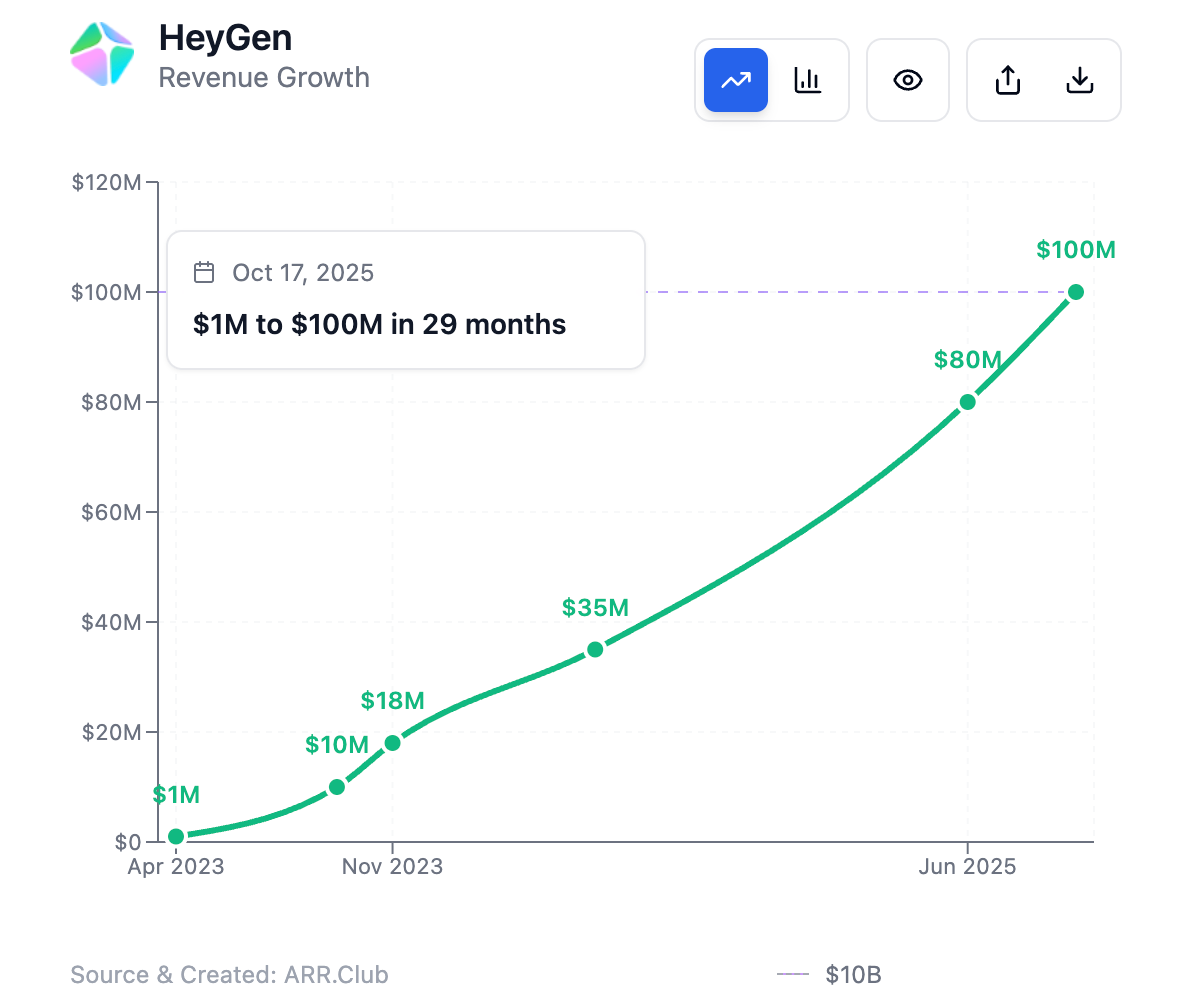
At the end of June, I shared that HeyGen had surpassed $80 million ARR and released Video Agent.
Today, HeyGen announced that its ARR has surpassed $100 million, growing from $1 million in April 2023 to $100 million in 29 months.
HeyGen founder Joshua published a long post on X, sharing their product philosophy — here’s a concise summary.
Joshua wrote that HeyGen’s mission is to make visual storytelling accessible to everyone.
Their core strategy is to ride the AI wave as it evolves — not to wait for a stable foundation.
In the traditional software era, companies pursued stability, planning, and refinement. HeyGen instead pursues speed, experimentation, and learning.
Their advantage lies in learning and iterating faster than anyone else, and turning technological instability into a product strength.
Two Types of Videos
HeyGen classifies videos into two categories:
Communication Videos — tutorials, podcasts, interviews, explainers; the focus is on information delivery.
Cinematic Videos — ads, films, music videos, trailers; the focus is on emotional impact.
HeyGen focuses on the first category — enabling anyone, from beginners to professionals, to create high-quality communication videos within minutes.
From Foundation to Wave
The key philosophical shift:
Traditional software builds on stable foundations.
In the AI era, there is no stable foundation.
So HeyGen chooses to “ride the wave.” He emphasizes: “Technology can be unstable, but the product experience must always be stable and reliable.”
Move fast, and do it excellently. Embrace uncertainty.
Bet six months ahead of the AI wave. Build products that automatically upgrade with model evolution.
The 2-Month Wave Cycle
HeyGen’s product rhythm operates on a 2-Month Wave Cycle, aligned with AI’s rapid evolution:
2-Month Roadmap — synchronized with AI model updates
6–12 Month Strategic Bets — anticipating future model breakthroughs
Biweekly Commitment Lists — defining each team’s deliverables
Daily Releases — maintaining a continuous learning loop
This short-cycle rhythm keeps the team moving at AI speed —
long enough to build meaningful products, short enough to adapt to rapid change.
The Experiment System
HeyGen’s experimentation model is fast, scientific, and learning-oriented.
Each cycle looks like this:
Day 1: Define hypothesis and success metrics
Day 2: Build MVP
Days 3–5: Launch to a subset of users
Week 2: Review, learn, decide
Core principle: experiments must be fast (within days), failure is fine — but learning is mandatory.
“If it fails and we learn, we win.”
When making decisions, they ask: is it a one-way door or two-way door?
If reversible, act immediately — no long discussions.
All decisions are transparent on Slack, with clear accountability (“who’s responsible” and “when to execute”).
Speed + ownership replaces bureaucratic approval.
Technical Philosophy
HeyGen’s engineering principles: flexibility and replaceability.
Expect change, but don’t over-abstract
Version everything
Reduce technical debt = invest in future speed
Joshua summarized it clearly:
“Speed is everything, and it’s non-negotiable — because in the AI era, the team that learns fastest wins.”
He adds that teams must embrace technological instability — because stability no longer exists.
AI infrastructure evolves every two months.
Design your products so they automatically improve as models evolve.
Build adaptive abstraction layers that grow with AI’s progress — not against it.
Team Structure
All teams follow a four-corner structure: PM (Product) + Eng (Engineering) + Design + Data
PM: Owns the “Why” — drives decisions and priorities
Engineer: Builds fast, stays flexible, prototypes with PM
Designer: Ensures simplicity and universal usability
Data Scientist: Validates hypotheses and quantifies outcomes
HeyGen has a “Prototype First” culture:
Teams of 2 (PM/Design + Engineer)
Don’t seek consensus — seek validation
Prototype → User Test → Refine
Every feature must pass a quality threshold before launch
Everyone can build prototypes. In the AI era, what’s possible to build is infinite, but the key is having a fast-moving, decisive team.
Two Product Teams flywheel
HeyGen’s product organization splits into two:
Core Product Team — focuses on foundational product experience; defining what HeyGen is, refining usability, completeness, and long-term vision.
Growth Product Team — driven by experimentation and learning.
Their philosophy: “Engineering is a tool; impact is the goal.” Experiments exist not to win, but to learn. Internal communication follows an Async First principle.
Seven Development Traps to Avoid in the AI Era
Joshua shared seven anti-patterns to avoid:
Perfect Architecture Illusion — spending weeks “designing for scale.”
Over-Researching Instead of Shipping — “Ship wrong, learn fast, ship right.”
Waiting for AI to Stabilize — “It never will — ride the wave.”
Consensus Trap — “Everyone agrees = no one cares.”
The ‘Not Perfect Yet’ Excuse — “Ship confidently, improve fast.”
Big Bang Launches — spending 6 months in stealth while competitors ship and learn.
Sunk Cost Fallacy — “Kill failures fast.”
Joshua concluded that HeyGen’s success stems from shipping 5× faster than competitors.
Every day, we face a choice: Chase false stability, or ride the wave. HeyGen chooses to ride the wave — to build products that evolve in sync with the evolution of artificial intelligence itself.
Some Other Chinese AI are also exploding
HeyGen is a prime example of AI founded by a Chinese team that has achieved remarkable success.
Beyond HeyGen, there are many other AI companies founded by Chinese entrepreneurs that have also performed exceptionally well — such as Manus and Genspark. Manus has already reached $90M ARR, while Genspark has surpassed $50M ARR.
1. Manus hit $90M ARRR in 5 months
2.Genspark hit $50M ARR in 6 months
However, the next 2 AI I’ll mention are relatively new players. Despite this, they have each already achieved over $30M and $40M in ARR, respectively, in a remarkably short time.
