
Granola: The $250M “Second Brain”
AI should be a “jetpack for the mind”

The AI note-taking market is crowded. We’ve seen apps like Read AI, Abridge, Fathom, Freed AI, each of which has soaring growth.
And two college dropouts built an API for meetings that has surpassed $10M ARR after 3 pivots, proving that transcription-based products can scale.

But Granola is different. It has become one of the most talked-about startups in the venture world, having raised a total of $67M in funding and achieved a valuation of $ 250M.
When Granola closed its $43M Series B in May, the company was already repositioning itself.
What began as a personal second brain had grown into a team second brain, with the product now emphasizing the value of data storage and the network effects of collaboration.
From Notes to Networks
Two new features highlight Granola’s ambition to move beyond transcription and toward relationship intelligence.
People & Companies: Launched last week, this sidebar view organizes all notes around the people and companies that matter most to you.
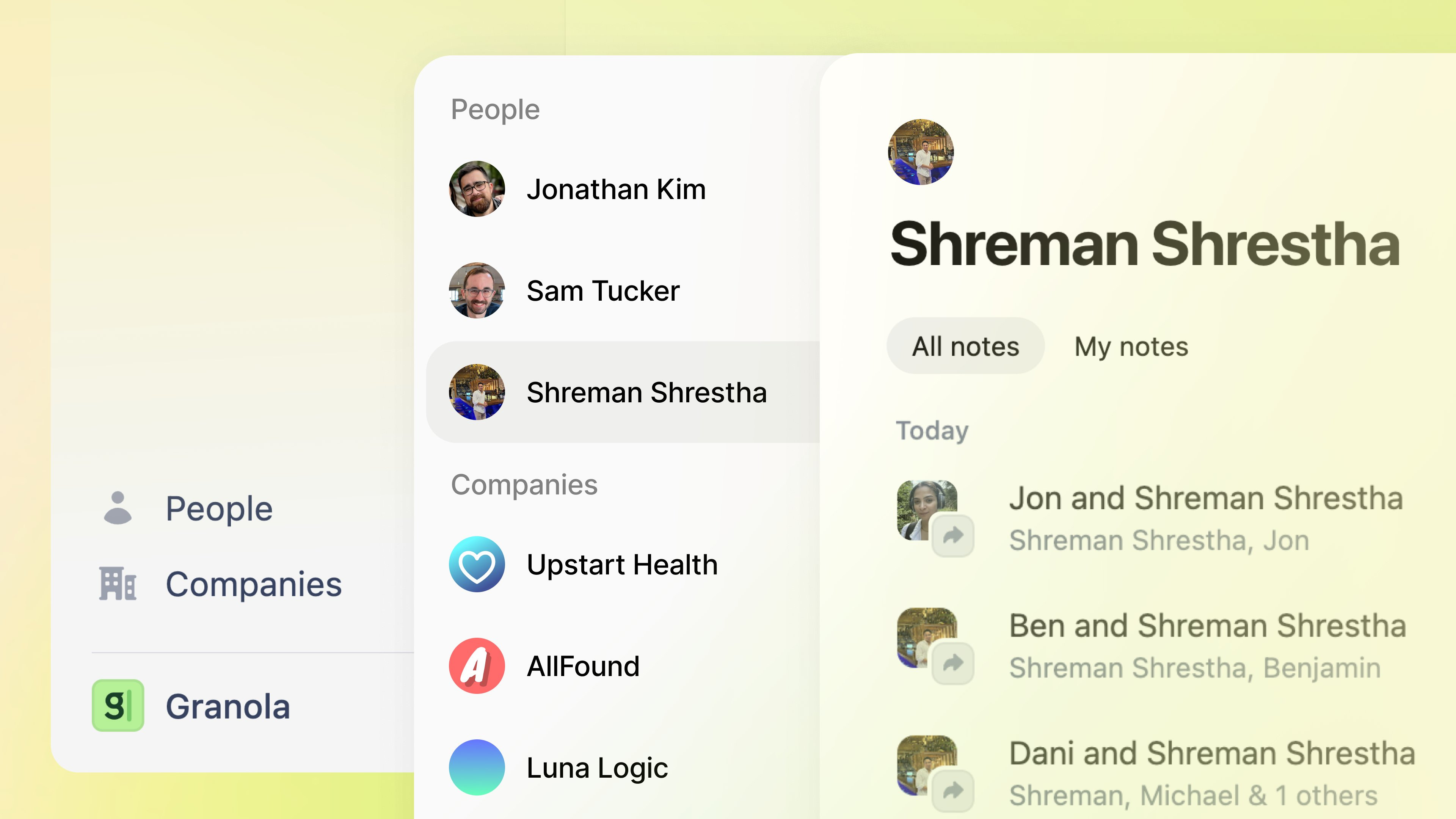
Every conversation becomes part of a bigger picture: instead of isolated transcripts, Granola maps out the relationships behind them.
For investors, founders, and professionals who live in back-to-back meetings, this is a direct strike at the core workflow.
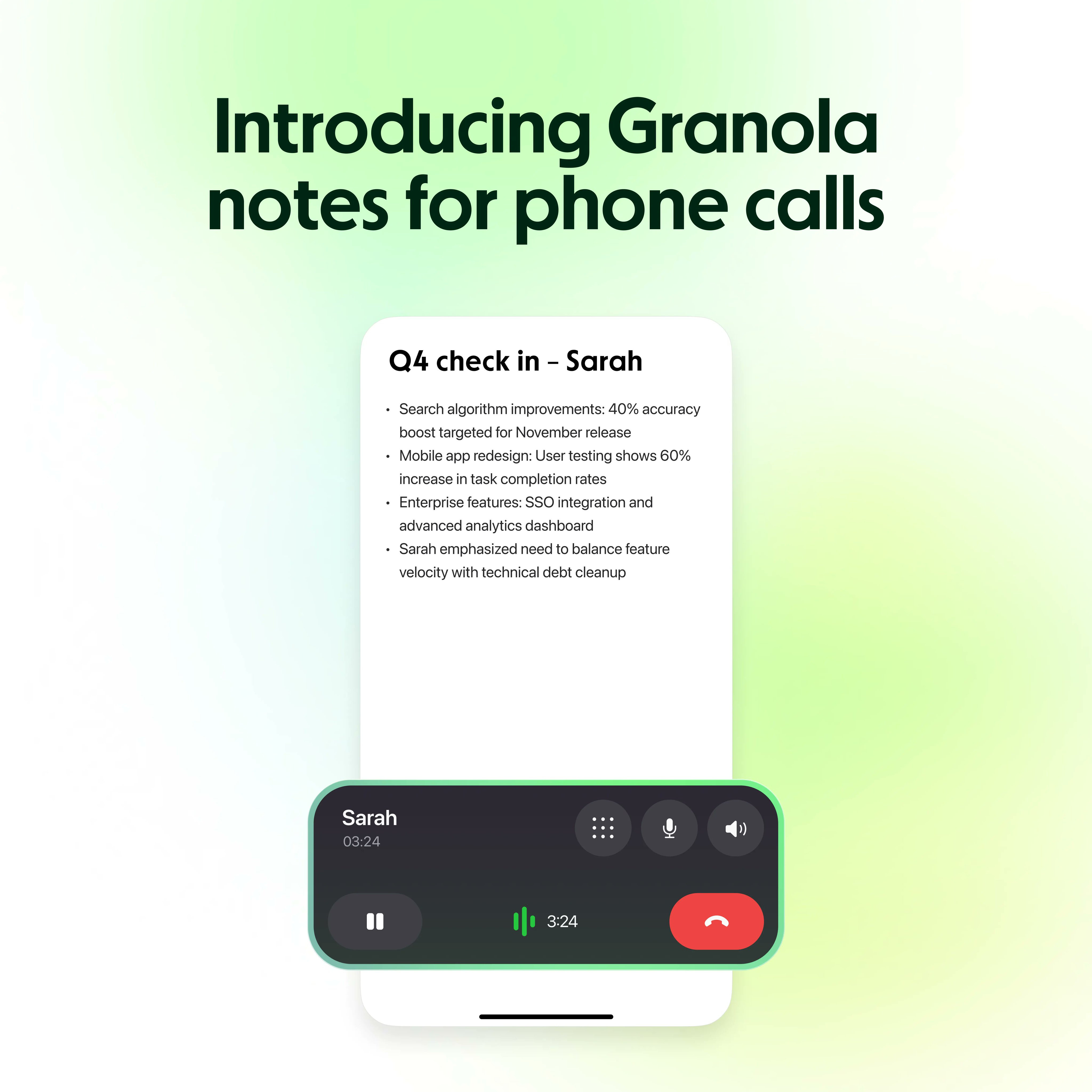
Phone as a Capture Device: Earlier this week, Granola rolled out native phone integration on iPhone.
By binding your number, you can make calls directly through Granola, which records and organizes the content in real time—even with headphones on.
Competitors like Plaud.ai have approached this problem with hardware. Granola’s software-only solution means it now covers nearly every communication surface: meetings, chats, and phone calls.
Ecosystem Integrations: Notes can now flow directly into Attio, the AI CRM that has raised over $100M, where they’re automatically linked to the right person, company, or deal.
Granola also integrates with Zapier, instantly connecting to more than 8,000 apps. This is a classic SaaS playbook: nail a wedge use case, then scale distribution and value through integrations.
The Philosophy Behind Granola
Founder Chris Pedregal describes Granola not just as a tool, but as a thinking aid. The vision is bold: AI should be a “jetpack for the mind.”
From Notes to Thought Infrastructure: Granola’s long-term ambition is to evolve from personal note-taking to a collective brain for teams, and eventually into an intelligent workspace that reshapes how humans process information and collaborate.
Minimalism as Differentiation: The product rejects meeting bots, avoids storing raw audio, and deliberately cut 50% of planned features pre-launch. This radical simplicity builds trust and keeps the focus on usability. Granola wants to feel like an intelligent notebook, not a surveillance system.
Context as the Moat: Chris believes that LLMs are only as useful as the context they can access. Meetings are the richest source of fresh, real-time context—a 30-minute call can generate 40 pages of text. By capturing this data at scale, Granola creates the raw material for more advanced use cases.
Narrow Focus, Deep Value
Instead of chasing general-purpose AI like OpenAI, Granola is focused on specialized, high-value users: investors, founders, and knowledge workers who must capture critical details with precision.
This focus has led to contextualized outputs: for example, summaries from a fundraising meeting differ depending on whether you’re the founder or the investor. This role-based customization is what Granola calls “context design.”
Chris even frames Granola as a Trojan horse. By starting with transcription, the product quietly builds a massive corpus of contextual data.
Tomorrow, that same data could power more ambitious use cases: analyzing thousands of meetings to help investors identify the next lead check writer, for instance.
The “Best Model Wins” Strategy
Unlike some startups, Granola doesn’t build its own large language models. Instead, it takes a pragmatic approach: adopt the best model available, and switch as the market evolves.
The team believes that in the long run, the moat won’t be the model. It will be the data, product experience, and integrations—all of which compound over time.
Why Granola Matters
Granola has done something rare in productivity SaaS: it has kept its product simple while still evolving its ambition.
By focusing on relationships, context, and ecosystems, the company has differentiated itself from a sea of AI note-taking tools.
If Granola succeeds, it won’t just own meeting notes. It will own the relationship graph of work itself—and that could make it one of the most strategically valuable productivity platforms of the AI era.