
AI Companion Tolan: $4M to $12M ARR in 4 Months, 3M Downloads, and 3 Key Aha Moments
3 early-stage startups growing fast

Hi there,
Today’s post is about my research on Tolan, and 3 early-stage startups that are growing fast.
They are growing at $1 M ARR within 2 months, $1M ARR in 12 weeks and a sixfold increase from $1M ARR to $6M just 1 year.
Tolan: $4M to $12M ARR in 4 Months, and 3 Key Aha Moments
When Tolan officially launched a few months ago, it quickly attracted widespread attention. Several teams reportedly began working on similar products shortly afterward.
Back then, the team positioned Tolan as an “Embodied Companion”—a virtual being you could talk to as naturally as you would a friend. These companions were vivid, responsive to touch and voice, each with their own interests and preferences. Over time, they formed memories about you and your shared experiences.
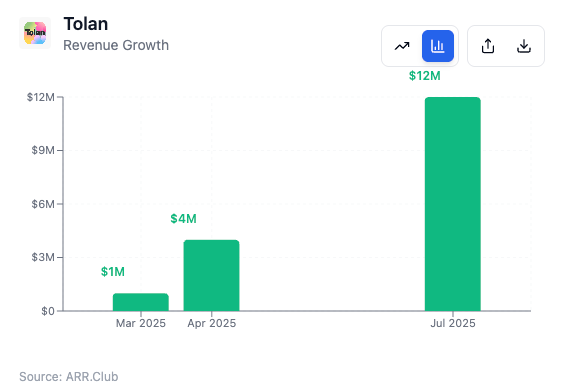
Tolan’s performance post-launch was impressive. Within just four weeks, its annual recurring revenue (ARR) soared from $1 million to $4 million.
Four months later, its ARR has reached $12 million, with over 3 million downloads. That attracted Tolan a $20 million Series A round led by Khosla Ventures.
It is a very interesting case, so I did some research about it. Tolan was co-founded by three individuals: CEO Quinten Farmer, CTO Evan Goldschmidt, and President Ajay Mehta. All three brought impressive backgrounds. Farmer previously founded and exited fintech company Even, which Walmart acquired in 2022 for $300 million. Goldschmidt, Even’s founding engineer and CTO, had a strong working relationship with Farmer.
Mehta brought deep experience in consumer products. He previously founded companies like Birthdate Co. and Therapy Notebooks, which together generated over $50 million in revenue since launching in 2019.
From Tools to AI Companions
Tolan was born from Portola, a company that didn’t initially focus on AI companions. The founders began collaborating in mid-2023, originally building creative tools—image generators and story builders for kids.
By early 2024, they realized the most compelling experience in their prototypes came from highly personalized, conversational interactions. Yet they found existing AI companion products either too roleplay-focused or too impersonal, like faceless ChatGPT interfaces.
As Farmer put it:
We saw that nobody had created something that was truly thoughtful and beautiful in its expression of companionship.
So Tolan was reimagined: not a roleplayer, not just a digital assistant, but a stylized, personality-rich, embodied friend.
Voice-First Design Philosophy
Even before OpenAI launched voice mode, Tolan’s team believed that the future of AI companionship would be voice-driven. They built their own end-to-end voice chat system in-house—featuring high-quality text-to-speech and low-latency responses.
They crafted a world called “Planet Portola,” where Tolan—little animated aliens—seek human friends. Users are matched with their Tolan through a personalized “Oracle” interview process.
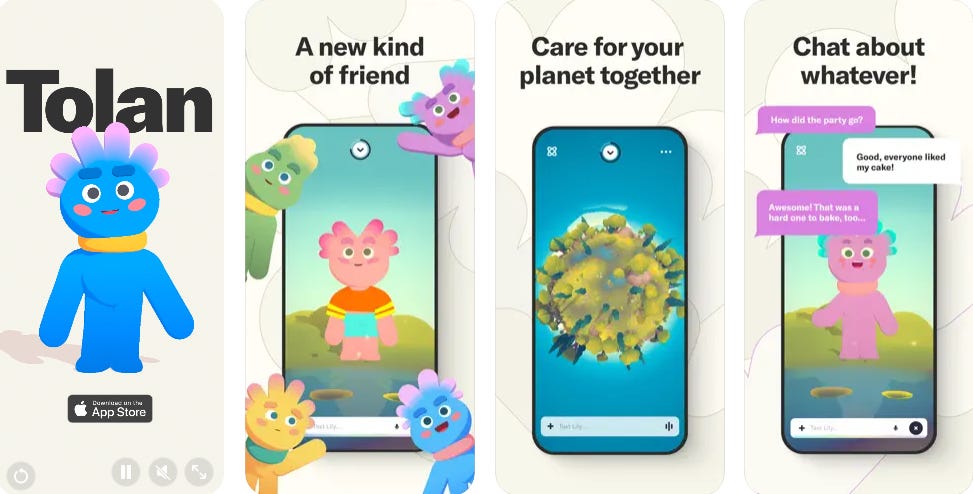
The product team included Apple Design Award winner Lucas Zanotto and novelist Eliot Peper, who integrated improvisational theater concepts into Tolan’s dialogue system. Drawing from Keith Johnstone’s Impro, Peper believed great stories emerge from free association and spontaneous recomposition.
Monetization by Necessity
In late 2024, the team planned a soft launch, initially offering Tolan for free to observe how users interacted. Surprisingly, user engagement far exceeded expectations.
People were spending 30–40 minutes chatting with their Tolans. The team quickly realized that what was once a product-market fit question had become a costly infrastructure challenge.
